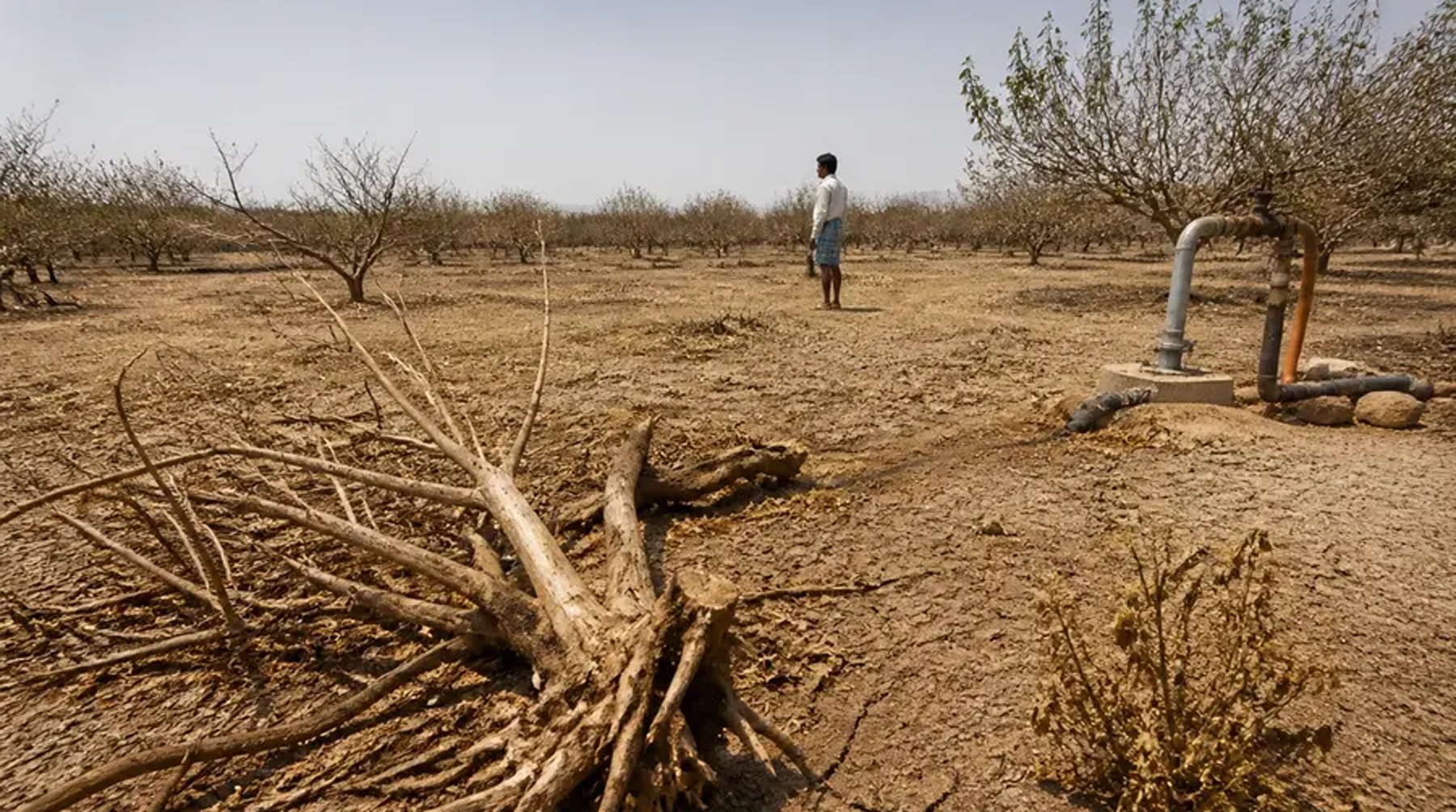
As rainfall deficit deepened agrarian distress, CPI(M) Andhra Pradesh state secretary V Srinivasa Rao demanded that the central government announce a special package of ₹1 lakh crore to tackle the severe drought prevailing across the state. Addressing the media in Vijayawada on September 13, along with party state secretariat members, Srinivasa Rao said that 655 of the state’s 688 mandals were experiencing a rainfall deficit. He expressed concern that sowing had not been completed on 80% of the kharif area and that crops sown in some areas had already suffered damage.
He stated that the state had already incurred crop losses amounting to ₹5.40 lakh crore. He pointed out that the government had advised farmers in the Krishna and Godavari deltas to undertake sowing, assuring them that water would be supplied in time. However, with inadequate water available in the reservoirs, farmers were now deeply anxious about the survival of their crops. He also highlighted the scarcity of drinking water and criticised the unannounced power cuts, particularly in rural areas. He said the power outages were preventing farmers from operating agricultural bore wells needed to irrigate their crops.
The CPI(M) demanded the immediate announcement of a drought-relief package, fulfilment of the agricultural loan-waiver promise, a complete waiver of interest on DWCRA loans, provision of 200 days of work under the rural employment guarantee scheme, payment of minimum wages, implementation of new pension schemes from October and distribution of eight essential commodities through fair-price shops.
Rainfall Deficit Deepens Agrarian Distress
The Planning Department issued a statement highlighting the severe rainfall deficit in the state and its likely impact on various sectors. Officials reported that more than five lakh hectares of cultivable land had already been left fallow because of the adverse conditions.
The department expressed concern over the impact on the livelihoods of people in rural areas and warned that further difficulties could arise unless precautionary measures were taken. The prolonged rainfall deficit is expected to affect agricultural production, reservoir levels, groundwater recharge, rural incomes and consumer demand.
A decline in agricultural output could reduce farmers’ incomes and weaken purchasing power in rural areas, affecting demand for consumer goods and services. With rainfall remaining below normal during the critical kharif season, the Planning Department noted that both agricultural activities and rural livelihoods were at risk, posing a significant challenge to people who are primarily dependent on agriculture.
Meteorologists have warned of a severe impact from the El Nino phenomenon this year. Concerns have also been raised that the agricultural sector is facing a crisis because adequate precautionary and proactive measures were not taken by the government.
Many tenant farmers said they were in distress, stating that they had paid lease amounts in advance but had fallen into debt after being unable to sow their crops. Agricultural labourers were promised 125 days of work under the employment guarantee scheme, but concerns have emerged about their livelihoods after the allotted period of work had ended.
Demands were raised to extend drought-relief employment to 200 days and ensure payment of minimum wages. It was also demanded that the state government urge the Union government to announce a special drought-relief fund in view of the severe conditions and declare the affected areas drought-hit so that adequate assistance could be provided to farmers, tenant farmers and agricultural labour families.
Drought Hits Districts across State
The situation is particularly severe in Anantapur district. CPI(M) State Secretariat member Rambhupal demanded that the state government immediately provide drought relief, stating that crops had withered and drought conditions had emerged in the district amid the El Nino-associated rainfall deficit. A CPI(M) delegation inspected villages in Garladinne mandal and examined groundnut crops. In Marthadu village, tenant farmer Imam Vali said he had incurred expenses of about ₹2 lakh on lease costs, cultivation and other expenses for four acres of groundnut.
Residents, including Girijala Venkatalakshmi, said their crops had completely dried up. Farmers in Parchuru mandal expressed distress over the severe shortage of drinking water. Villagers said fields remained uncultivated because of the lack of rainfall and that drinking-water tanks had dried up. They also reported that an RO plant had remained non-functional for three months. According to the villagers, the plant wasted four litres of water for every litre of purified water produced. They said they were forced to travel 30 kilometres to fetch drinking water, paying ₹20 per can.
Anakapalli district normally receives about 330 mm of rainfall, but only 145.7 mm was recorded, resulting in a 52% deficit. Paddy cultivation in the district normally covers about 1.31 lakh acres during the Kharif season. However, by July 24, transplantation had been completed on only 12,500 acres, indicating the severity of the rainfall deficit. Farmers are facing severe hardship, compounded by the absence of sugarcane cultivation. Rainfall deficits exceeding 60% have been reported in several mandals. The lack of rain and resulting soil-moisture deficiency have made paddy transplantation difficult, while crops already sown are also suffering from water scarcity. As a result, farmers are unable to cultivate their lands, their incomes have been severely affected and many have fallen into debt.
In Palanadu district, there has been little or no rainfall for the past three months, severely affecting agriculture. Cotton farmers have reportedly been carrying water from distant locations in pots and other household containers to keep their crops alive. In Vizianagaram district, agricultural tanks and wells have dried up. Paddy sowing has come to a halt on around 1.25 lakh acres because of the water shortage. Paddy, the major crop in the district, has seen the area under cultivation decline by more than 50%. So far, paddy has been sown on only about 1.23 lakh acres this year, compared with more than 2.5 lakh acres during the corresponding period last year.
NTR district, located just a few kilometres from the state capital, Amaravati, is also reeling under severe water scarcity. Groundwater levels have declined, and many domestic wells have dried up. Nearly 225 village water tanks, or cheruvus, have dried up. Except for Prakasam Barrage, all major water-storage facilities in the district were reportedly at negligible or nil storage levels. The situation has severely affected agriculture and resulted in loss of livelihoods in rural areas.
With the exception of one or two districts, the situation is similar across most parts of the state. Although some rainfall was recorded in August and September, it has reportedly been insufficient even to meet drinking-water needs, let alone provide adequate water for irrigation.
According to data from the India Meteorological Department (IMD) cited in the report, Andhra Pradesh normally receives 424.1 mm of rainfall during the June–August period. The state recorded only 197.6 mm during the same period, indicating a substantial rainfall deficit. Most districts have reported significant rainfall deficits, resulting in declining groundwater levels and growing concerns over agriculture.
According to the Andhra Pradesh Water Resources Information and Management System (APWRIMS), nearly all districts in Coastal Andhra and Rayalaseema have experienced deficient or large-deficient rainfall during the monsoon months. Annamayya recorded severe rainfall deficits of around 73–76%, while Prakasam recorded deficits of around 65–70%. Nandyal and Kurnool recorded deficits ranging from about 55–64%. Coastal districts, including Eluru, Alluri Sitharama Raju, Krishna and Guntur, recorded deficits averaging about 44–57 %, while Nellore and Tirupati recorded deficits of approximately 35–43%, although these were lower than those recorded in several interior districts.
As of September 1, 2026, the combined water storage in the state’s reservoirs was reportedly 216.33 TMC lower than the storage recorded during the corresponding period last year. Groundwater levels are also reported to be declining steadily, with the average level said to have fallen by around 50 feet. In a majority of districts, drinking-water scarcity has become a serious concern, affecting not only agriculture but also other sectors, including industry.
Rural Distress Intensifies; Protests Announced
The inflation rate in the state is currently reported to be around 9.5%. With prices of essential commodities continuing to rise, the financial burden on households has increased.
The Andhra Pradesh Rythu Sangham, the Andhra Pradesh unit of the All India Kisan Sabha (AIKS), and the Andhra Pradesh Vyavasayaka Karmika Sangham, the state unit of the All India Agricultural Workers Union (AIAWU), issued a joint statement on the drought situation. The organisations decided to stage protests at all mandal offices for three days from September 21, protesting against the government’s handling of the drought situation.
They demanded that the government immediately announce a clear action plan to address the drought and officially notify the drought-affected areas. They also called for the preparation of a contingency plan.
According to the organisations, sowing could not be undertaken on 55% of the state’s agricultural land because of the drought. In several areas, there is also a shortage of drinking water and fodder for livestock. People in many villages are facing difficulties due to the lack of employment opportunities caused by the drought.
A team comprising state-level leaders of farmers’ unions, tenant-farmer associations, agricultural workers’ unions and rain-fed farming organisations will tour the state to assess the drought situation. The organisations also expressed concern over the difficulties faced by workers following the introduction of new legislation replacing the employment guarantee scheme. Even where work is available, they said, wages are as low as ₹30 a day. They demanded that 125 days of employment be provided to every person willing to work in all villages. Livestock and small-ruminant rearers are also worried about the shortage of fodder.
The organisations said crops had been lost in many areas because of inadequate rainfall and irrigation water. Farmers had already struggled to obtain remunerative prices for their produce, while rising prices of essential commodities had further increased the burden on rural households. They alleged that the Chief Minister had encouraged farmers to cultivate crops despite early warnings and therefore demanded that the government bear responsibility for the losses. They called for compensation to affected farmers, including payment of interest.
In addition to the demand for loan waivers, the organisations demanded free distribution of seeds for alternative crops and sought clarification on the areas in which the distributed seeds should be cultivated. They urged the government to immediately undertake drought-relief works and take steps to protect the livelihoods of people affected by the drought.


