Editorial

The Bogey of ‘Regime Change’

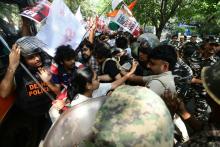
FACED with growing protests over the large-scale electoral malpractices initiated by the supposedly neutral umpire, the Election Commission of India, which clearly favours the BJP, the government and the ruling party have gone berserk. Like a drowning man clutching at straws, the ruling party and its army of social media foot soldiers are pulling out the charge of regime change. Obviously, the desperation betrays the efforts to distract from the substance which has galvanised the protests.

Cannot Stop Spring from Coming

PABLO NERUDA’s immortal lines read thus: “You can cut all the flowers, but you cannot keep spring from coming”. These words were the ultimate declaration of the inevitability of collective triumph of the people for a cause worthy of humanity and civilisation. What started as a struggle to salvage electoral democracy, an essential element of our republican constitution from an obnoxious assault on the right to vote has developed into one of the biggest battles for democracy in contemporary India.

Enough is Enough

THE independent constitutional authority, Election Commission of India, tasked to conduct free and fair elections, today stands like the naked Emperor. Since the Special Intensive Revision (SIR) was launched on June 24, 2025, for Bihar, it was clear that it was not intended to clean up the electoral rolls. It had no precedent contrary to what was claimed by the ECI nor was it backed by any formal decision nor based on any due diligence to hold the exercise across the nation as was made out during launch.

The Vilest Subversion

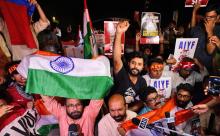
EVER since the Special Intensive Revision (SIR) of the Electoral Rolls was launched, we have been chronicling the trajectory of the process through reports and Editorials in the People’s Democracy. This process has been mired in controversy since its inception on June 24, 2025, in Bihar.

Lethal Recipe for Destruction of Indian Economy

EVEN before the dust had settled down over the bombastic and unbelievable claim by Modi that in the last quarter Indian economy has grown by 7.8 per cent, the charge that the government has capitulated before the US and the Trump administration over the imposition of 0.4 per cent charge in some categories of digital transactions through the Unified Payments Interface (UPI) has completely exposed the pusillanimity of our economic administrators. A host of issues do call the bluff that the Modi government indulged in.

‘From the River to the Sea, Palestine Will be Free’

MODI’s narrative about him administering homeopathic medicine is largely a self-inflicted assault. Far from being a successful strategy it is proving to be a self-goal – a case of unmitigated frustration. To brand all those who have views contrary to the regime and Hindutva as “dimagi naxals” leads to only one inescapable conclusion: that all those who support Modi and his ideas are “gair-dimagi andh bhakts”.

Bunking Won’t Block the Truth

AMIT SHAH’S absence from the Lok Sabha during the entire Monsoon Session was quite bizarre. Even after being present in the Parliament premises, he was consciously but quite obviously staying away from the House. The grotesque attacks on the protesting students and youth at Jantar Mantar during their march to the Parliament, provoked widespread revulsion. In turn, the joint Opposition’s pointed demand for the Home Minister’s specific explanation, put him in a tight spot.

In Defence of Free Speech

EVEN some time back, it would be unthinkable to imagine that free speech needed to be defended. The Indian freedom struggle, which fought back the draconian laws of the British rule, had discarded obnoxious attempts to snuff out freedom of speech and expression. The provisions of the UN Human Rights Charter to which India was a signatory, and the Indian Constitution itself, enshrined iron clad safeguards. Those were different times; critical thought was indisputable.

Unmaking the Constitution, Remaking the Republic

THE nature of Indian democracy was established based on principles which were tempered in the course of the freedom struggle. Hence, it was not a coincidence that the Constitution was established after a protracted debate in the Constituent Assembly for almost three years. This was the institutionalised quintessence of values and ideas which evolved while adopting and customising some of the universal principles experienced and practiced by democracies elsewhere in the world.

Pages

Subscribe to RSS - Editorial