From Bizarre to Systematic Subversion: Rigging of Electoral Democracy
Nilotpal Basu
VERY recently the eloquent reticence of the Chief Election Commissioner of India, Gyanesh Kumar, has given way to an extremely brief observation. He has opined that notwithstanding the ‘little inconvenience’ of some citizens, the Special Intensive Revision (SIR) carried out across the country was necessary to clean up the Electoral Rolls for conducting a ‘fair election’. This could be regarded as the greatest understatement of the century.
Ever since the unleashing of the SIR in Bihar last year, it has dominated not just electoral disputes, but the larger political process in the country. In hindsight, apart from the content of the process itself, the integrity of the independent Constitutional body, the Election Commission of India (ECI), is also under a cloud. At the time of launch of SIR, the ECI had asserted that this was nothing unusual and is a replication of what was done in 2002-03 for cleansing the Voters List. The ECI has been less than economical with the truth because neither was the choice of the reference point nor the precise text followed in 2002-03 ever put out in public domain. However, very recently the guidelines for 2002-03 SIR have found their way in the open.
It establishes the entire contention as outright misrepresentation and a falsehood. In keeping with the methods employed in drawing up the Electoral Rolls since its inception, the 2002-03 exercise did not require a voter to submit an application for enlisting oneself in the rolls. But the exercise initiated in 2025 made a fundamental departure by listing 11 documents which needed to accompany voters’ application forms, which would firmly secure their place in the rolls. This was apart from their names being linked to names of either of their parents in the rolls for elections prior to 2002-03. This was a sleight of hand after announcing that such persons mapped with such parental linkages would not have to submit any further documents.
There was also a timeline which was too short to conduct a thorough revision. Despite the strongest opposition from all those who were opposed to the BJP, the ECI went ahead with a nonchalance bordering on arrogance. This was a stark contrast with the convention followed thus far of the ECI acting only on the basis of a consensus across the political spectrum as and when such drastic measures had been envisaged in the past. The results of the Bihar SIR itself were enough to send the warning signal which had led to deletion of 65 lakh names. Psephologists and domain experts had explicitly aired their apprehension that across the country this can balloon up to 10 crore names. The apologists of the ECI and the ruling dispensation had poo-poohed this projection. But now after the publication of the Draft Rolls where SIR has taken place, without Nagaland and Tripura, the number actually stands at 13 crore 37 lakhs. This does not include Himachal Pradesh and Jammu & Kashmir where SIR is yet to take place.
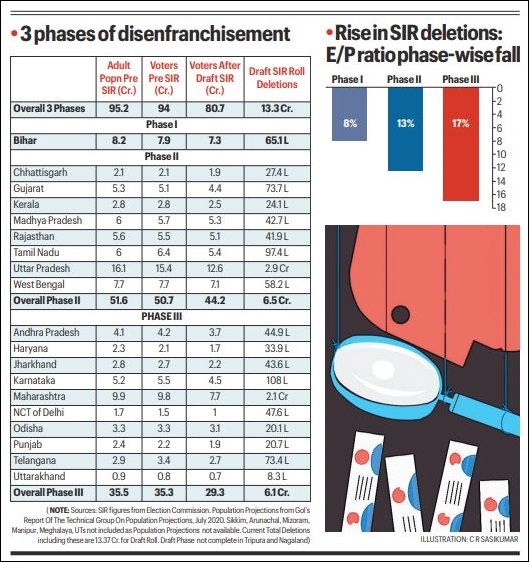
The accompanying table was published in Indian Express on 8th September (Draft SIR List shows statistical absurdities. Audit by an independent agency is needed.).
What is more damning is not just the sheer numbers, but the comparison with the corresponding population of the country with reference to specific states. The figures actually can have only two possibilities – either undercounting of the voters or over counting of the population. Since both the counts are carried out by government agencies, there can only be one explanation that the SIR Draft Rolls itself has indulged in large scale exclusion.
EXCLUSIONARY EXERCISE
But how is that possible, because the eligibility to appear in the Voters List is defined by Article 326 of the Constitution which has subsequently been amended to extend the right to 18-year-olds? It reads: “The elections to the House of the People and to the Legislative Assembly of every State shall be on the basis of adult suffrage; that is to say, every person who is a citizen of India and who is not less than eighteen years of age on such date as may be fixed in that behalf by or under any law made by the appropriate Legislature and is not otherwise disqualified under this Constitution or any law made by the appropriate Legislature on the ground of non-residence, unsoundness of mind, crime or corrupt or illegal practice, shall be entitled to be registered as a voter at any such election.”
The reference to citizenship of the voter is tangential. The ECI does not have the constitutional prerogative to decide the citizenship of a voter. It can only cross check with the concerned authorities in the Home Ministry to exclude the name of a voter from the Electoral Rolls. In the protracted judicial proceedings in the Supreme Court itself, the highest judiciary has reiterated this without any ambiguity.
But nevertheless, voters have been removed. And the SIR exercise has been decidedly exclusionary. The scrutiny of the state wise result made this out more pronouncedly. The most controversial exercise has been conducted in West Bengal where, after the mapping and the release of initial draft, a third layer was created based on a random algorithm driven flagging of ‘logical discrepancy’. With intervention of the Supreme Court, 19 Judicial Tribunals were created, comprising judicial officers, to examine the efficacy of the ECI’s decision to exclude. Ultimately, 38,10,620 appeals were to be examined by these tribunals. The initial impression was that most of these would be of those voters whose names had been deleted. But what has now come to light is that 31 lakhs of these were appeals for deletion of names already included. From the miniscule 82,782 appeals which have been examined and adjudicated, 91 per cent have been restored.
So far as applications for rejecting names, not just in West Bengal, but elsewhere as well, there are charges of large-scale irregularities. That these were mainly engineered by the BJP and led to pressuring of Booth Level Officers (BLOs) to drop the names through bulk submission of Form 7. This is completely violative of the election laws enacted by Parliament. It will be useful to refer to the Indian Express editorial on 11th September. “In at least four booths in Godda, a stand-off between election officials and BJP workers has thrown up a disturbing pattern: of BJP workers submitting Form 7s in bulk, seeking deletion of names from the draft rolls. Under the Registration of Electors Rules, 1960, Form 7 allows an objection to a proposed inclusion, an existing name or a request for deletion. The red flags here are unmistakable – bulk objections by BJP workers do not merely invite accusations of procedural violation, they raise the graver concern of targeted deletion of minority voters. Many of those marked for deletion had submitted the required documents, lived in the same house for generations, or were mapped onto the 2003 rolls.”
“For, across states, the SIR increasingly looks designed not to clean rolls but to harass, and in the process, disenfranchise the vulnerable voter. It is distrustful of her, it asks her to establish belonging, or, more correctly, counter the accusation of unbelonging that is implicit in the exercise. Nationwide, the SIR … shifts the burden of proof onto the voter, demands documents that are often difficult to access, sets unrealistic deadlines and, in doing so, makes the process itself the punishment. This must be owned by the Election Commission under the watch of CEC Gyanesh Kumar.”
But the misuse of Form 7 is not limited to Jharkhand alone. Similar allegations had been there about Uttarakhand, and it seems that not only are the BJP activists trying to crudely rig the list, but the final action of the election Authority, starting with the BLO to the Electoral Returning Officer (ERO), these brazen attempts are getting official patronage. The common thread which binds all these together is the conspicuous silence of the ECI over such irregularities. The other feature which became obvious during the West Bengal exercise was that of the around 7 lakh applications for restorations, the outcome of the examination by the Judicial Tribunals which were in any case extremely limited and geographically concentrated in Kolkata (not in the districts which ought to have been far more dispersed to ensure access to judicial redemption), 91 percent were found to be fit for being restored back to the rolls. The fact that all those who remain in the ‘Under Adjudication’ list based on arbitrary logical discrepancies were denied casting their votes, makes the record all the more damning.
DISAPPOINTING ROLE OF JUDICIARY
Despite the production of explicit documentary and statistical record as well as the express flawed nature of the exercise in Bihar, the Supreme Court has refused to stay the proceedings of the SIR. While there can be no two opinions that the ECI’s has the right to be independent as enshrined in Article 324 of the Constitution, the Apex Court’s insistence to make this right absolute even in the face of clear evidence that the ECI has not been equally mindful of ensuring the constitutional right of the citizens is disappointing. No constitutional authority can have powers which lead to subversion and exclusions.
Further, threat to the unity and integrity of the country and the nation lies in the fact that exclusions show overwhelming disproportionality with minorities, dalits, women and the poor working people being at the receiving end of disenfranchisement. This is evident after scrutiny of the draft Electoral Rolls state wise and the specific patterns of exclusions. Even if one is inclined to accept that such pursuits of disenfranchisement were to politically suit the interests of the ruling BJP, the identity specific outcomes went against the very grain of our constitutional spirit and foundation. Today with such corrupt and manipulated exercise in the background the impending census is also fraught with changes that appear to be linking the headcount with citizenship related issues. The launch of the new so-called Demographic Commission further aggravates the process. As per the constitutional scheme, the census process will form the basis of delimitation of constituencies. The entire pursuit seems to be creating and reconfiguring constituencies which will be electorally biased in favour of the ruling dispensation.
FUNDING IS NEW FAULT LINE
With the rejection of Electoral Bonds by the Supreme Court and adjudging them as unconstitutional, a brazen move towards clandestine corporate funding and obvious quid pro quo was thwarted. But the examination of detailed accounts of incomes of political parties has brought out the astronomically skewed nature of access of funds to the BJP. In the context of such funding abnormalities, the latest revelation by a BBC report indicates that there is danger of further distortions through illegal funding of political parties. There was already a report that there was a 223 per cent hike in the income of registered unrecognised political parties in the financial year 2022-23. The BBC report revealed that six Gujarat based registered un-recognised political parties raised around Rs.1,700.78 crore in donations in 2023-24. That’s at least Rs.200 crore more than the cumulative income of five national parties excluding the BJP. This was despite the fact that these parties hardly put up candidates. The Association for Democratic Reforms (ADR) in its report pointed out that five of these unrecognised political parties were Gujarat based and had a cumulative income of Rs. 2,316 crores between 2019 and 2024.
The BBC traced four of these parties to Ahmedabad while two others are headquartered in other parts of Gujarat. The evidence of such a strange nature of funding cannot per se establish wrongdoing. What is, however, unacceptable is the failure of the ECI to refer the question of such inexplicable funding for parties which virtually do not partake in elections, to agencies like Income Tax and Enforcement Directorate (ED). The ED in particular has earned notoriety for jumping at every small hint of financial wrongdoing which could be linked to opposition entities. Such over-zealous and often misplaced and biased pursuits have led to arrest of opposition Chief Ministers in the run-up to elections. But even after the BBC report, there has been no formal response from any concerned authority.
ELECTIONS STAND RIGGED
Since the adoption of the Indian Constitution and the holding of General Elections in 1952, India had earned the reputation of being the largest electoral democracy. Election authorities from across the world had come to study the practices which have largely proved to be unique and sustained with manifest credibility. But that appears to be a bygone scenario. The present direction of the conduct of elections has reached a dead end resulting from the government’s legislative action virtually transforming the ECI into an executive arm through the selection process of the Chief and other Commissioners. The faith of the citizens can no longer be sustained. Without ensuring a transparent election process with a level playing field and an independent ECI, the future is grim. The opposition parties also have to come together to demand more credible evidence of the conduct of independent elections which may even include the removal of the present incumbents at the helm of the election body.


