Vikram Singh
THE meeting of the General Council Meeting of the All India Agricultural workers Union held on July 25 and 26, 2026 at Alleppey (Alappuzha), of Kerala discussed in detail the prevailing political situation in India and at the international level to identify the challenges posed to agricultural and rural workers.
Alappuzha is an important district in the history of the agricultural workers’ movement, where the organisation of agricultural workers began to take shape in the 1940s. This region, especially Kuttanad and Punnapra-Vayalar, was a centre of anti-feudal and anti-caste resistance in the 1930s and 1940s. Poor farmers and agricultural workers faced extreme exploitation under a deeply entrenched feudal system. V S Achuthanandan was entrusted with the responsibility of organising these sections of the rural proletariat in a society where feudal landlords exercised almost complete control over the lives and livelihood of agricultural workers. A large number of these workers belonged to Dalit communities, particularly Pulaya and Paraya communities. They suffered from extreme poverty, caste oppression and humiliation, constant threats of eviction, physical violence, and social exclusion. Landlords treated agricultural workers as though they had no rights beyond providing their labour. Through the patient and sustained organisational work of Com V S Achuthanandan, the communist movement succeeded in creating a new consciousness among the rural poor. This work laid the foundation for the agricultural workers’ movement in Kuttanad and later across Kerala.
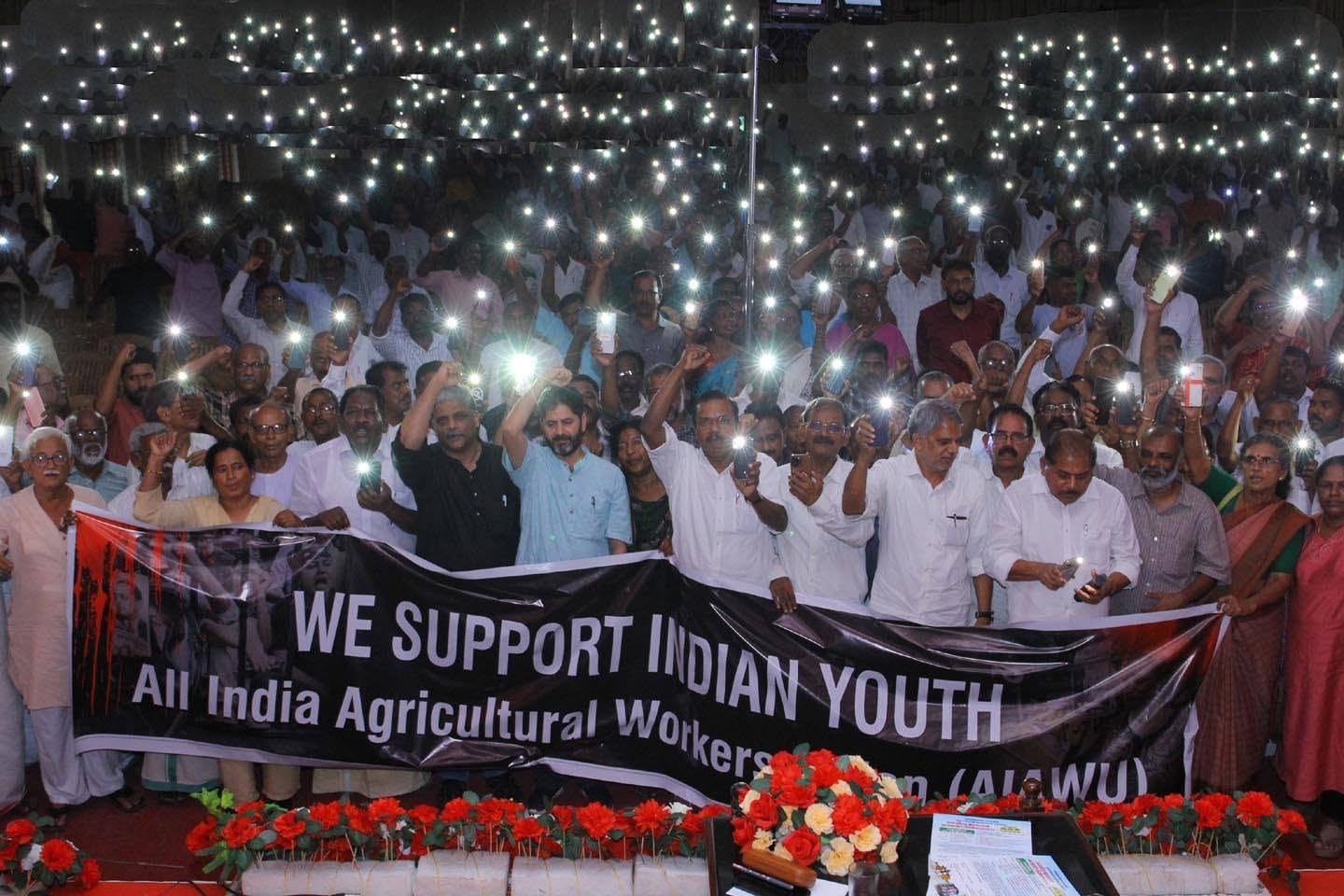
Before the General Council Meeting on July 24, 2026 a national seminar on agricultural and rural workers was organised which was attended by hundreds of agricultural and rural workers in the Makomb village. The speakers at the seminar were A Vijayaraghavan, B Venkat, and Vijoo Krishnan, AIAWU President, General Secretary, and AIKS General Secretary respectively. At the end of the national seminar, thousands of agricultural and rural workers gathered to show their solidarity with the youth of India.
The meeting began with paying of tributes to the martyrs of Punnapra-Vayalar and Comrade V S Achuthanandan along with other martyrs in the morning. This was followed by flag hoisting by A Vijayaraghavan, president of the Union. After flag hoisting, Com A Vijayaraghavan gave his presidential remarks and presided over the meeting. Com B Venkat placed the General Secretary’s report. The report observed that the BJP has further consolidated its political influence following its victory in the recent Assembly elections in five states. The capture of the West Bengal government, long regarded as one of the strongest bastions of the working-class movement, and the setback suffered by the LDF in Kerala have serious implications for Indian democracy and the working people.
The report was discussed by the members of the General Council, with representatives from the states sharing their experiences, observations, and assessments from their respective states. There was a detailed discussion on the struggle to save the right of work of the rural masses, the attack on MGNREGA and the implementation of VB-G RAM G. The General Council meeting decided following tasks:
Struggle for the right to work: One of the principal tasks for the coming period is to continue the struggle for the right to work. With VB-G RAM G now operational, the immediate responsibility before our Union is to ensure that rural workers receive employment and timely payment of wages under the new scheme. To begin with, our comrades must thoroughly understand the new procedures, rules, and implementation mechanisms of the scheme. We will launch campaigns in every state demanding the provision of adequate employment and organise struggles wherever the authorities fail to provide work or delay wage payments. At the same time, our leadership at all levels must equip itself with the technical, administrative, and legal aspects of the scheme so that we can effectively defend workers' rights, expose violations, and intervene wherever violations occur.
The General Council decided to take up issues related to the emerging drought situation. There are predictions of a weak monsoon this year, raising the likelihood of drought or drought-like conditions in several states in the coming months. State and district units will closely monitor the evolving situation and promptly take up the issues affecting rural workers. They will launch agitations demanding immediate and effective relief measures from the government, including adequate employment, food security, drinking water, and compensation for affected families.
The meeting also discussed the proposed amendments to the Antyodaya Anna Yojana, which are likely to further undermine the food security of the most marginalised sections of society. The proposed changes seek to replace household-based entitlements with individual-based quotas, thereby reducing the total quantity of foodgrains received by many households. The Union will organise struggles demanding that the Public Distribution System (PDS) be universalised and that the government provide additional allocations of cereals and pulses to all eligible households.
The meeting decided to focus on the basic issues of class struggle, take these issues of land, wage, and housing to the people and make them realise their rights.
The meeting expressed serious concern over the increasing attacks on Dalits, Adivasis, and minorities across the country. The Union resolved to take up the issue of social justice and resist the policy and social attacks on the socially and economically oppressed sections. Our units will visit the families of victims of caste atrocities and communal violence, extend solidarity, and organise struggles to ensure justice, punishment of the guilty, adequate compensation, and proper rehabilitation for the affected families.
While working among Dalit and Adivasi habitations, our organisation will take up struggles for basic civic amenities, housing, drinking water, education, healthcare, land rights, and employment. Alongside these immediate economic and social issues, we will intensify the ideological struggle against the Manuvadi-Hindutva ideology, which seeks to perpetuate caste oppression, social discrimination, and communal division among the working people.
AIAWU will also intervene in the issues of forests being destroyed for land and mining, and launch a nationwide campaign against it. We will undertake an extensive campaign demanding the immediate implementation of the Women's Reservation Act without linking it to the delimitation process. The misleading propaganda of the BJP-led central government must be effectively countered through sustained mass campaigns, exposing its delay and highlighting the urgent need to ensure women's political representation.
Rural Workers: The meeting reiterated that organising rural workers remains a priority task, as has been emphasised in almost every meeting of our organisation. Most state units have already changed the names of their organisations to include rural workers. However, the meeting stressed that a mere change of name will not by itself achieve this objective. This historic opportunity must now be translated into concrete organisational initiatives.
Although some state units have made encouraging initial efforts in this direction, these are only the beginning. As we prepare for the forthcoming All India Conference, we must place special emphasis on this task. By the time the Conference is held, we should have gained practical experience in organising rural workers, understood their specific problems, and developed forms of struggle suited to their conditions.
This is an opportunity to expand our organisational base and transform our union into a genuine organisation of the rural proletariat, representing all sections of the rural working class and strengthening their unity in struggle. Only through such efforts can we build and intensify the struggle of the rural proletariat against the ruling classes, including the capitalist landlord class.
All India Conference: The 11th All India conference of the union will be held on 7, 8, 9, 10 February 2027 in Bengaluru, Karnataka. Meeting decided that the total number of delegates for this conference will be 773.
It was decided that the All India Conference will be utilised to activate the rank and file of the organisation and rejuvenate its functioning at the village level. It will also serve as an opportunity to strengthen the scientific and democratic functioning of the organisation and combat any alien tendencies if that may have emerged. In the run-up to the conference, state units will organise seminars, lectures, blood donation camps, health check-up camps, library festivals, cultural programmes and other social activities to mobilise members and expand the organisation's reach. The conference preparations will include thematic seminars exposing the dangers of Hindutva and highlighting its adverse impact on the lives and livelihoods of agricultural and rural workers.
State conferences/conventions will elect delegates through democratic procedures while ensuring adequate representation of Dalits, Adivasis and minorities. At least 20 per cent of the delegates elected from each state must be women. Special efforts will also be made to ensure greater participation of young comrades. The composition of each state's delegation should reflect the actual struggles and movements being carried out in that state. Along with leaders serving in higher organisational committees, comrades who are leading and building local struggles should be given the opportunity to participate in the conference so that the discussions are enriched by their practical experiences.
The coming six months are of critical importance in the life of our organisation as we move towards the 11th All India Conference. This period is crucial not only for rebuilding and strengthening our organisation but also for enhancing its ideological clarity and political orientation.
It is equally important to recognise that, at the present juncture, the ruling classes have intensified their attacks on the toiling masses. The BJP-RSS-led government continues to pursue policies that favour rural and urban exploiters while aggressively advancing its divisive communal-Hindutva agenda. At the same time, the struggles of the working class and the growing movements of students and youth have generated immense hope and opened new possibilities for broad-based resistance.
It is our responsibility to mobilise the rural proletariat against this nexus of the ruling classes. The anti-people policies of the ruling classes have created widespread anger and discontent among the people. Our task is to transform this anger into sustained and organised struggles. To achieve this, we need an organisation that is deeply rooted in the villages, with active committees capable of leading local struggles and uniting the rural working people.
This will be the guiding line of our work in the coming year. By strengthening our organisation at the grassroots and intensifying class struggles, we can build a powerful resistance against the nexus of corporate exploitation and communal-Hindutva politics.


