Samprikta Bose
HISTORY stands as witness: whenever waves of struggle have swept across the nation, Kolkata has never backed down. Whether it was the historic Rashid Ali Day of 1946 or the fierce street solidarity with Vietnam's liberation struggle in the 1960s, the boulevards of Kolkata have repeatedly erupted into an ocean of surging youth. The radical legacy Kolkata carries in its veins proved no different this time.
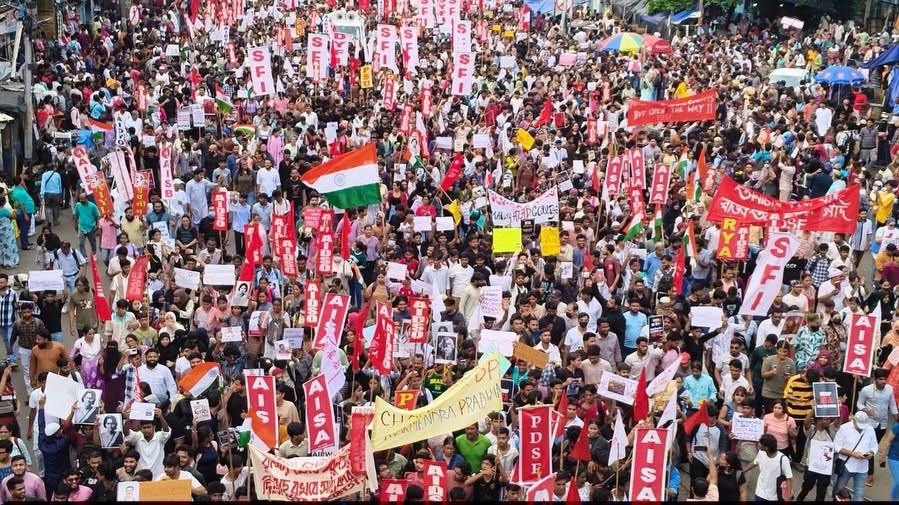
There are certain moments of protest in the pages of history that transcend the boundaries of time, inspiring generation after generation. Over the past month, the capital has witnessed the creation of just such timeless moments. Naturally, the pulse of the young generation’s brave fight at Delhi’s Jantar Mantar—rising above party lines, dogmas, and faiths—had already echoed through Kolkata. Predictably, the mainstream media turned a blind eye, completely oblivious to the storm brewing right under their noses. What Kolkata witnessed on July 24, 2026, was no simple organised rally—it was an overwhelming, unstoppable deluge of student fury.
The distance from Sealdah to Dharmatala is roughly 2.7 kilometres. When the head of the rally reached Dorina Crossing at Esplanade—the political heart of this city of defiance—its tail was still at Sealdah Station. This was no sponsored crowd, nor a mob dragged in by force—it was, in the truest sense, a human ocean.
MOSAIC OF RESISTANCE
What made this rally extraordinary was its sheer social composition. Fiercely anti-Left fathers—once influential heavyweights of previous political regimes—were seen marching side by side with the youth, dragged along by their tenth-grade daughters. The city had not witnessed such a sight in a long time: young women, many wearing burqas, coming from deeply conservative backgrounds, standing with unshakeable resolve alongside university researchers and school students. Such resolute youth, such vibrant slogans, music, and the vocal defiance of adolescence and youth—this iconic picture of uncompromising student struggle is something Kolkata had not witnessed in a generation.
Participants carried the Indian national flag alongside portraits of Bhagat Singh, Che Guevara, Pritilata Waddedar, B.R. Ambedkar, and Raja Rammohan Roy. Placards demanding educational justice appeared alongside creative street theatre, songs, and spontaneous assemblies. Volunteers actively cleared discarded food packets and water bottles to keep the march clean, exemplifying a highly disciplined yet passionate public mobilisation.
This congregation transcended party lines, leaped over the barbed wires of political colours, and broke down the barriers of religion, caste, and political affiliation. They gathered for a singular purpose: to demand just, rational education and to assert an unyielding desire to build a hopeful future. There is no machinery of oppression ever invented by any power on Earth that can permanently halt, crush, or extinguish such a collective spirit.
CORE DEMANDS
What were they demanding? Echoing the roar of Jantar Mantar, they called for the immediate resignation of Union Education Minister Dharmendra Pradhan and the abolition of the National Testing Agency.
"Driven to the brink by the NEET scandal, twenty-two souls have taken their own lives. These are no isolated incidents. The chaos over the CBSE Class 12 results was a complete mockery. Taking full responsibility for all of this, the Education Minister must step down."
Student leaders pointed out that over the last decade, at least 150 competitive and recruitment examinations have been left hanging in limbo, marred by paper leaks, administrative delays and corruption. The protesters declared the central testing framework utterly dysfunctional. But even that was not the whole story—the movement quickly broadened to question the systematic commercialisation of public education, rising application fees, delayed research fellowships and the erosion of democratic rights across campuses.
Addressing the central government's indifference, SFI State Secretary Debanjan Dey remarked that no one made Narendra Modi the Prime Minister of this country just to see him become a content creator posting late-night videos. Instead of indulging in such antics, Dey asserted, had the Prime Minister stood in Parliament in broad daylight, owned up to responsibility, and relieved his incompetent cabinet colleague Dharmendra Pradhan of his duties, it would have served a real purpose.
SUPPRESSION EFFORTS
What began as a 12-hour sit-in by the Students' Federation of India outside the College Street campus of the University of Calcutta on July 22 expanded into a joint platform of eight Left student organizations by July 24. As the massive procession reached Dorina Crossing around 5:00 PM, Kolkata Police erected heavy barricades, sealing off Rani Rashmoni Road and Jawaharlal Nehru Road. With tens of thousands overflowing the intersection, student leaders requested authorities to open the barricades toward Rani Rashmoni Road to ease the dangerous overcrowding.
Delays in opening the passage led to heightened tensions. Around 5:45 PM, police personnel advanced with lathis. When a section of the crowd reacted by throwing water bottles, police executed a sweeping baton charge, injuring numerous demonstrators. Despite the force, hundreds of students sat firmly on the asphalt, continuing their chants. Recognising the impossibility of dispersing the gathering, police officials eventually negotiated with student leaders, removed the barricades, and allowed the assembly to move to Rani Rashmoni Road, where protests continued late into the night.
In the aftermath, police arrested sixteen protesters, prompting widespread charges of political persecution. Chief Minister Suvendu Adhikari and other political figures defended the administration, condemning the marchers and calling for strict action, while student bodies accused political provocateurs of attempting to instigate violence to justify the crackdowns.
The Chief Minister's knee-jerk reaction was a sight to behold. He immediately attempted to smear the universal character of the rally with ugly communal insinuations, terming it a "Friday crowd." His cronies descended to even viler depths, labelling the protesters as jihadis and traitors, declaring they should be hacked down, and threatening that anyone raising slogans of Azadi would be paying a visit to the hospital before reaching home.
JUDICIAL INTERVENTION
The legal turning point occurred on July 28, when a Supreme Court Bench headed by Chief Justice Surya Kant, alongside Justices Joymalya Bagchi and V. Mohana, intervened in matters concerning student protests nationwide.
The apex court firmly stated that peaceful protest is a constitutionally protected right and warned state authorities against adopting repressive measures. It mandated the immediate release of demonstrators under eighteen years of age with no prior records, ordered the preservation of all video and digital evidence, and proposed the creation of a Special Investigation Team headed by a retired judge to investigate allegations of police brutality while also examining injuries sustained by police personnel.
Following these observations, the Bankshall Court in Kolkata granted bail to all sixteen detained protesters on July 28. Despite securing bail for the arrestees and the subsequent resignation of Dharmendra Pradhan under sustained national pressure, student organizations have refused to back down. Subsequent rallies along College Street have continued to demand the complete withdrawal of all criminal cases filed against student activists and the formal abolition of the National Testing Agency.
As State President of the SFI Pranay Karjee and State Secretary Debanjan Dey asserted at the conclusion of the July 28 mobilisations, the victory achieved so far is only partial. The uprising that began on the streets of Kolkata has evolved from an immediate protest against exam irregularities into a sustained national movement—one that refuses to rest until public education is restored as an uncompromised, universal democratic right.


