Srijan Bhattacharya
INDIA witnessed history. For the first time in twelve years, the Narendra Modi government was forced to bow down in front of its people to an extent where a close aide of his had to resign. In an unprecedented turn of events following the NEET paper leaks, the CBSE OSM evaluation irregularities and the CJI's derogatory remarks on the youth of this country, the social outburst of the Gen Z's pent up anger and frustration about the present dispensation led to the biggest mass movement of India, unique in its character, in the recent times, and eventually compelled Union Education Minister Dharmendra Pradhan to resign. This was, as the GenZ calls it, highkey huge. Massive.
We all know by now how events unfolded. The NEET paper leak was not a small scam. 22+ lakh examinees were affected, with more than 20 of them losing their lives. On the very day the papers got leaked, i.e., May 12, 2026, SFI was the first students' organisation of the country to come out on the streets demanding resignation of Dharmendra Pradhan and justice to the affected lot. Sources say this was the 151st paper leak of the country in the last 12 years. In terms of central examinations, the SFI's concerns went beyond resignation of a minister, as we also demanded the removal of NTA, and finally, the withdrawal of NEP 2020 as a policy, because that is where it all stems from.
JANTAR MANTAR BECOMES EPICENTRE
The mainstream media, as usual, did not pick up the plight of NEET aspirants as an issue in the beginning, and tried to keep the people oblivious of it for as long as possible. But the angst of the youth started taking shape in digital spaces soon, following the CJI's comment that the youngsters of the country are useless like 'cockroaches' and 'parasites'. Within days, the social media handles of the 'Cockroach Janta Party' swelled with millions of followers, indicating the early signs of awakening of a dormant volcano. Gen Z's discontent around the government started to show, and by June 6, the CJP gathered enough mass support to stage a public protest at Jantar Mantar, New Delhi.
SFI was there from the very first day in this movement. As an organisation which had already been mobilising public opinion in all states on the same issues, the SFI resolved that along with taking up independent initiatives, it was absolutely necessary that it participated in the mass gatherings of the cockroach movement and reach out to the people coming there with its political messaging. Despite all apprehensions about the nature of the CJP leadership, we decided to be a part of the movement, clearly knowing that our role here is to extend solidarity to the common concerns raised by the spokespersons of the movement about the government’s failure to conduct transparent examinations, and at the same time, independently push for further structural reforms in the education sector to make it a more egalitarian and democratic one via the mass movement.
A steady growth of Jantar Mantar as the epicentre of the movement began as scientist and social activist Sonam Wangchuk soon joined, declaring an indefinite hunger-strike demanding accountability from the central government regarding the paper leaks. Activists of AISA also joined the hunger strike. SFI, in accordance with the position of the CJP team, decided that it would join the hunger strike when CJP does, and as of now, act together in mobilising students more and more into the movement. The CPI(M) and other Left parties extended solidarity in all possible ways. Leaders of different non-BJP social and political outfits as well as the secular intelligentsia were also present at the Jantam Mantar dharna.
Soon, Jantar Mantar became a site where people from different parts of the country, irrespective of caste, creed or religion, started to arrive and stay together. Crowds began to spend days and nights interacting with each other, and in no time, this became a space that was a live statement against the politics of hatred and otherisation advocated by the RSS-BJP. This is an important aspect of this movement because it showed how an issue concerning all citizens can bring people together despite continuous venomous propaganda by the godi media and the infamous BJP IT Cell. The protest felt like a celebration at Jantar Mantar, with thousands of people from all walks of life flocking every day. SFI's stall, Kranti Corner, played an important role in keeping Jantar Mantar vibrant.
The movement went through a qualitative change when Sonam Wangchuk, on the 21st day of his hunger strike, was forcibly abducted by the Delhi Police from the Jantar Mantar Dharna. Protests erupted throughout the country. The movement, till then one of a predominantly student-youth character, began to take the shape of a mass uprising. Civil society started to speak up, and major uproar started developing against the undemocratic move by the Delhi Police, which is directly controlled by the central Home Ministry. SFI All India President Adarsh M Saji and All India Joint Secretary Aishe Ghosh joined the indefinite hunger strike along with CJP frontman Abhijeet Dipke. Huge spontaneous waves of crowds began to reach Jantar Mantar, and the protesters called for a peaceful Parliament March on July 20.
THE TURNING POINT
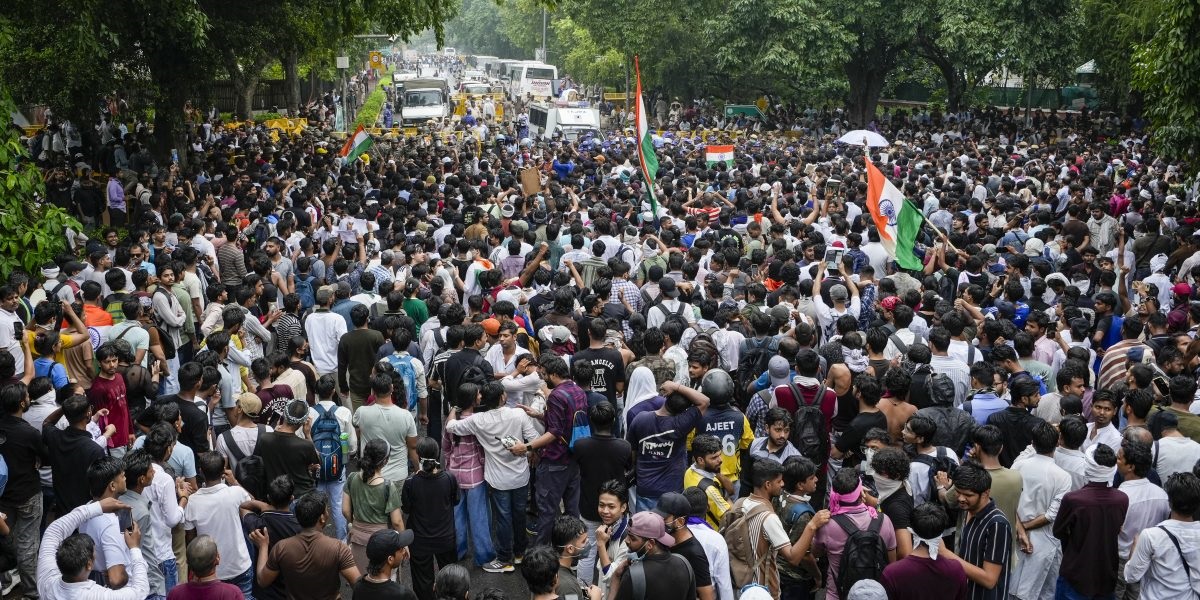
July 20 marked a watershed moment for the movement. From the night before, thousands of people started to gather in New Delhi. Their demand was simple, accountability from the government for the education mismanagement and hence, resignation of Dharmendra Pradhan, the education minister. The government had every option to resolve the issue by engaging in a dialogue with the protesters, but instead, they chose the path of unbridled violence. Jantar Mantar was turned into a Jallianwalla Bagh, with barricades put all around the protest site. Huge contingents of police, RAF and other forces were brought to New Delhi, even from other states, to combat the innocent students. It felt as if the government had declared war upon its own people. It was simply the protesting people on one side, and the entire state machinery, waiting to bring down a merciless crackdown on the masses, on the other.
Barricades broke. In spite of all attempts by the police to stop the rally, tens of thousands of students reached the streets leading to Parliament. Nobody intended to capture Parliament. All they wanted was the government to pay heed to their grievances. The Prime Minister fled. After a while the police began lathi charging in an indiscriminate manner. Tear gas, thorned dandas, electric shock, pellet guns were used to silence the protesters. For hours, the heart of the national capital witnessed unimaginable brutality on behalf of the police. Innocent protesters were manhandled, molested, detained. RSS goons, camouflaged as part of the police forces, attacked the masses. The world saw, with astonishment, how brutal a government can be on its own people. Thousands were affected, with a few hundred having serious injuries. Over 40 SFI activists had to be taken to hospitals for primary medical treatment.
RENEWED FIGHTBACK
Here is when the masses showed their resilient character. At every step when the government thought that they would dismantle the movement by coercion, the protesters came back with newer vigour. By evening, the crowds regrouped and gathered back at Jantar Mantar. It had been ransacked by Delhi Police by then. From its debris, the movement was reborn. The cockroaches declared aloud, not an inch back from here. Either Pradhan resigns, or the uprising grows bigger. There's no midway here. Whole of India was boiling with anger against the police atrocities on innocent civilians. With bruises and cuts and bandages, students reclaimed the National Flag and patriotic slogans and directed them towards the undemocratic Modi Government by the night of July 20.
Adding to the BJP's dismay, massive protests of youngsters broke out in different parts of the country. Especially, Kolkata, Patna and Mumbai saw massive crowds coming out on the streets in solidarity with the cockroach movement. In 23 states, from Kerala to Assam and Himachal to Telangana, SFI led huge protests against police brutality. The brutality continued in states as well, but the waves of Gen Z protesters never seemed to cease. It showed in their unique innovative humorous ways of voicing their dissent that the fear of state repression was taken over by the courage and determination to foster a change. The anger against the fascistic Modi regime, which culminated in demanding immediate resignation of Dharmendra Pradhan, was visibly real in all parts of the country.
After a few bipartite talks with the CJP representatives, the government agreed to accept most of their demands. Two important demands were compensation to the NEET victims' families and withdrawal of all cases against protesters. Agreeing to both, the government tried to negotiate the resignation of Dharmendra Pradhan till the last. By then, this was not in the hands of CJP either. The masses made sure that they would settle for nothing short of the resignation of education minister. Demands were raised for public apology from the Prime Minister for the July 20 atrocities. Sensing that the movement has spread throughout the country, and no amount of hate campaign or repressive approach would be possible to defeat the protesters anymore, in the afternoon of July 25, Dharmendra Pradhan resigned.
We saw the new generation put its foot down and say: ‘Enough is enough, your divisive designs can't fool us anymore.’ This was, indeed, historic.
FUTURE PATH
Now the more complicated question arises. Which way shall CJP go? Will the masses realise their full potential, or will the movement limit itself to achieving resignation of one minister?
Well, for now this can be said, the SFI will tirelessly work to bring all forces together demanding not just ornamental changes, but real structural reforms in terms of education policies of India. We shall have a close watch on the CJP team and analyse which way they want to direct themselves. The cockroach movement developed a democratic plane that definitely had certain anchors, but more than them, it was the masses who spontaneously carried forward the movement based on common minimum demands. Now, it is the task of SFI to pursue further interventions to save the broken public education system of India. We shall leave no stone unturned to accomplish our goals.
Marx, in his Critique of Hegel's Philosophy of Right, wrote that an idea becomes a material force when it is appropriated by masses. India, from May-July 2026, witnessed an uprising that cut the so-called invincibles to their size, in an impactful manner. This resistance from within the people was very, very necessary, all the more, because this taught even the fascists that the power of the people is much, much greater than the people in power.


