M A Baby
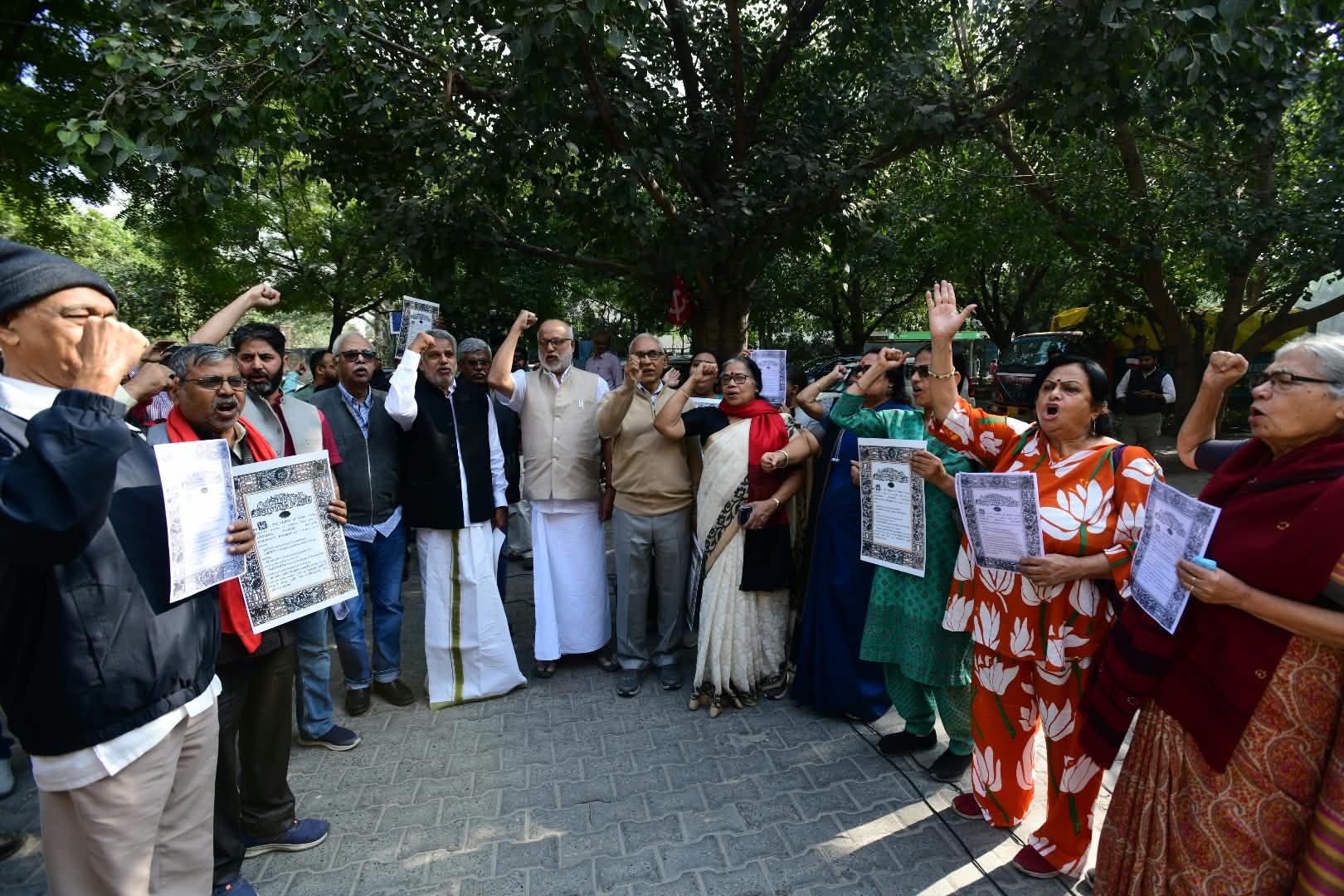
TODAY, the most frequently referred to book in India is the Constitution of our Republic. Every day, innumerable serious issues are being taken up connected with the lives and the livelihood of different sections of society in our courts, which naturally brings up various constitutional positions and debates relevant to the matter. Therefore, it would be appropriate to recall from where we started our journey of constitutional values and its vicissitudes.
Seventy-seven years ago, on November 26, 1949, the Constituent Assembly adopted a charter that was, for a poor and deeply stratified land emerging from colonial subjection, an act of extraordinary audacity. It promised every adult, irrespective of property, caste, gender or creed, an equal place at the ballot box. B R Ambedkar, who piloted that document through fierce contention, knew that the promise was fragile. A day before adoption he told the Assembly that India would enter a life of contradictions where political equality will exist alongside social and economic inequality, one man one vote in politics, but one man one value denied in the social and economic structure.
After 2014, Hindutva authoritarianism and neoliberal capitalism have fused into a single architecture. Their ideological claim is ‘cultural’ where the nation is a Hindu nation, and minorities are guests whose citizenship is conditional. And their material claim is corporate where the economy concentrates wealth at the summit and the mass of working people are offered the language of aspiration in place of entitlement. The constitutional claim is sort of managerial where institutions are instruments to be captured, packed up or bypassed. Each claim reinforces the others. The majoritarian state treats protest as sedition and it creates the political calm in which capital can extract profits without accountability. The neoliberal order dismantles welfare and produces the precarity that makes communal mobilisation useful to the rulers.
Ambedkar insisted that constitutional morality, not merely the text, sustains democracy. He warned against the grammar of anarchy, but that warning was attached to a vital condition that constitutional methods must remain genuinely open. He warned against bhakti in politics, against hero worship, calling it a sure road to degradation and eventual dictatorship. He warned that a good Constitution turns bad in bad hands because its working depends on the people and parties who operate it. These can be taken as instructions for our Republic which would have to defend itself against the social forces that never accepted the idea of equal citizenship.
Federalism, the constitutional recognition that India is a union of states and not a unitary state, has been steadily hollowed out. Governors convert Raj Bhavans into outposts of BJP headquarters, delaying assent, summoning and dismissing governments according to political convenience. Central agencies, the Enforcement Directorate and the Central Bureau of Investigation, are deployed not against corruption in general but against opposition governments in particular. The proposed 130th Constitutional Amendment Bill carries this logic further, to create a mechanism by which elected ministers in non-BJP states can be removed on the strength of judicial proceedings that the central agencies themselves initiate. It would be a death knell for federalism and parliamentary democracy. The space for constitutional opposition has shrunk to a mere formality with the fusing of instruments of investigation and the offices of constitutional governors into a single partisan apparatus,
The capture of the electoral machinery is the most dangerous front because it touches the foundation of political equality itself. The Special Intensive Revision of electoral rolls has inverted the burden of proof. Enrolled voters, previously presumed to be citizens, are now required to prove their citizenship. Election Commissioners raised repeated objections to decisions issued without their consent. The Supreme Court upheld the revision, but its direction that names deleted over doubtful citizenship be forwarded to the Union government has built a pipeline from the voter roll to citizenship screening. When it is read alongside the Citizenship Amendment Act and the proposed National Register of Citizens, the real agenda becomes clear. These long-term objective are aimed towards the implementation of a graded citizenship project, a hierarchy in which some citizens possess rights by birth and others hold them at the pleasure of the state. Ambedkar called graded inequality the essence of the caste order. The Hindutva project of RSS-BJP seeks to reproduce it at the level of citizenship itself.
Analyses of deletions have shown a disproportionate removal of women, of Scheduled Caste and Scheduled Tribe electors, and of minorities. Disenfranchisement is also a material sentence for those affected. In Bihar, the chief minister declared that deleted voters would be ineligible for rations and welfare schemes, and lakhs were removed from ration lists. The West Bengal government adopted a similar posture. The Supreme Court has held that deletion does not automatically end citizenship and has expressed concern over denied food entitlements and caste certificates, yet exclusion continues. This should be understood as the convergence of the two assaults, the political and the economic. The state first removes names from the roll and then withdraws the ration card, the pension, the caste certificate. The working people, Dalits, Adivasis, women who migrate at marriage, informal labourers, are pushed out of both the political and the social wage. Documents, as Ambedkar understood, are a form of property and are scarce among precisely those whom the constitutional promise was meant to emancipate.
Meanwhile the economic contradiction that Ambedkar identified has deepened to the point of grotesquerie. The World Inequality Report 2026 records that India’s top ten percent capture 58 percent of national income while the bottom half receives 15 percent. The top one percent holds 40 percent of wealth. Upper castes own nearly 90 percent of billionaire wealth. The liberalisation regime promised growth that would lift all boats, however it has only produced a gilded age for a thin stratum and stagnant wages, insecure work and privatised public services for the many. Neoliberal policy and Hindutva have a symbiotic relationship. The policy supplies the material insecurity that makes communal scapegoating plausible and the fiscal austerity that starves the welfare state on which the poor depend. Hindutva helps the policy by intensifying the divide among the working class.
A Constitution depends on the morality of those who work it. Hero worship in politics degrades the Republic. Placing creed above country endangers independence itself. The present regime has made a cult of the leader, subordinated the state to the party, and the Constitution to the creed. It has turned constitutional bodies into instruments of political discipline and has used the machinery of citizenship to sort the population into first-class and suspect categories. It has allowed a tiny oligarchy to accumulate while the mass of working people are told that their sacrifices are a form of patriotism.
To defend the Constitution today is not to defend a text but to defend the principle that political equality cannot coexist indefinitely with social and economic inequality. It is to demand an immediate halt to the revision of electoral rolls, presumed citizenship for enrolled voters, the delinking of welfare from the voter roll, transparent dissent within the Election Commission, and independent appointment of Commissioners. It is to insist that federalism is not a concession to the states but the constitutional form of a plural Republic. It is to reject the graded citizenship that the ruling dispensation is assembling and to reaffirm the crucial promise of 1949 that one person is equal to one vote, which has one value.
Ambedkar asked how long Indians would live a life of contradictions. That question was a challenge to each generation to close the gap between the political equality of the ballot and the social and economic inequality of everyday life. This challenge has been pushed backwards by a regime that has made inequality its governing principle and majoritarianism its legitimising creed. The task before the working people, the peasantry, the Dalits and Adivasis, the women and the minorities, the students and youth, is to reclaim the Constitution from those who have emptied it of its transformative content. The struggle for constitutional morality is not antagonistic to the struggle for survival. It must be waged with the same clarity with which Ambedkar warned the Assembly, and with the same determination to ensure that the structure of political democracy is not blown up by those who promised equality and delivered only its contradiction.


