Jaswinder Singh
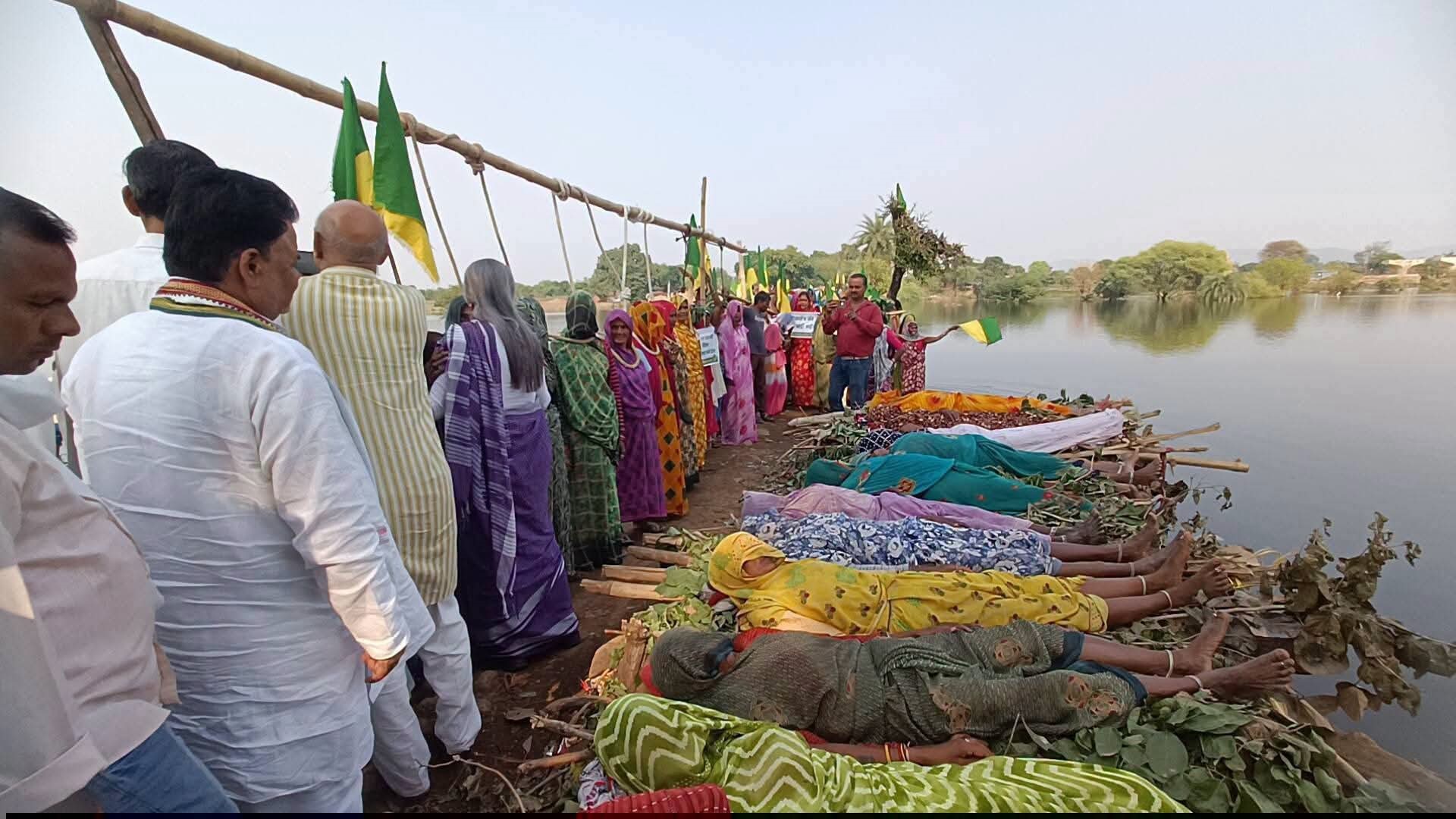
“IS demanding justice a crime?” Rani, an Adivasi affected by the Ken-Betwa River Linking Project, asks a delegation led by senior CPI(M) leader Brinda Karat. On October 26 and 27, Karat visited the people affected by the project to express solidarity with their struggle. It is noteworthy that 4,141 hectares of land are coming under the submergence zone, of which 1,314 hectares belong to the buffer zone of the Panna Tiger Reserve. According to the administration, 7,350 families from 21 villages will be affected by the project, whereas the actual number is estimated to be around 10,000. In addition, more than 2,000 families are likely to be affected by various dams being constructed in the Panna and Chhatarpur districts of the same region. All these people are carrying out a protest by lying on funeral pyres under the leadership of the Jai Kisan Sangathan. Around 60 per cent of these families belong to Adivasi communities. Rani, an Adivasi, is also part of this movement. She too has been lying on a funeral pyre, demanding either justice or death.
The delegation included Dull Chand Meena, national co-convenor of the National Platform for Adivasi Rights; Ramnarayan Kurariya; and Jaswinder Singh, Madhya Pradesh state secretary of the CPI(M).
Rani belongs to the village of Banhari Kalan Tapariya. She recounts that on the night of September 27, while she was at home, the police entered her house and began beating her, hurling casteist and gender-based abuses at her. They taunted her, saying, “You are very fond of lying on a funeral pyre. Now the police will make you lie down at the police outpost.” She was brutally beaten by male police personnel. Even her clothes were torn. The cots on which her children were sleeping were overturned, throwing the sleeping children onto the ground.
Another young man, Inderpal, an Adivasi, witnessed the police beating his mother and crossing every limit of brutality. Inderpal was helpless; he could not even protect his mother. He began recording the incident on his mobile phone. But the police would not tolerate this. They apprehended him, snatched and smashed his mobile phone, and brutally assaulted him. After keeping him at the police station for two days, they implicated him in a six-month-old attempt-to-murder case in another district. He was accused in a case about which he knew nothing and involving a place he had never even visited.
Several protesters have been implicated in similar false cases. However, the most striking case is that of Divya Ahirwar. Divya is a 24-year-old Dalit girl and a councillor of Bijawar Nagar Panchayat in Chhatarpur district. She is reportedly the youngest elected councillor in the state and an active member of the Jai Kisan Sangathan. She was apprehended and beaten by both male and female police personnel. She was dragged along the ground, and there are injury marks on her back and several other parts of her body. She was subjected to casteist abuse. The most outrageous act was that her kurta was torn off and she was made to walk for nearly two kilometres with her upper body exposed. Later, a woman police constable gave her a T-shirt to wear. She was assaulted and pressured to sign documents intended to implicate her in false cases. She refused to sign them. Nevertheless, false charges were brought against her, and Divya remains in jail to this day. On October 27, Brinda Karat, along with Jaswinder Singh and Amit Bhatnagar, a leader of the movement, met Divya Ahirwar in jail. They assured her and the movement of every possible support.
The fundamental question is: despite such severe repression, why are these unarmed and helpless Adivasis and rural people continuing their struggle? The reason is that, in the name of projects and development, the government has taken away everything they possessed. Their houses have been demolished without paying compensation. Electricity supplies to their villages have been disconnected to harass them. Their standing crops have been destroyed, and whatever has been offered in the name of compensation amounts to rubbing salt into their wounds.
Compensation for houses has ranged from Rs 60,000 to Rs 1.5 lakh. The only criterion considered has been whether a house is kutcha (non-permanent) or pucca (permanent). No compensation has been paid for the value of the land on which the houses stand. Compensation for agricultural land has been fixed at Rs 5 lakh per acre. Their standing crops have been destroyed without any compensation whatsoever.
The Land Acquisition, Rehabilitation and Resettlement Act, 2013, has been completely disregarded in the process of displacement. The provision of providing land in exchange for acquired land is entirely absent from the government’s rehabilitation package. Most importantly, no social impact assessment was conducted before the displacement process began. People who have lived together for generations are being uprooted, tearing apart their social relationships. They have also been deprived of the environment in which they have lived for generations and the livelihoods they have traditionally derived from the forests. No compensation has been provided for these losses either. Above all, they have not even been granted land titles under the Forest Rights Act.
A mandatory requirement for land acquisition is that, before initiating the acquisition process, a gram sabha must be convened to inform the villagers about the project and to seek their consent. However, whether it is the Ken-Betwa Link Project or other projects underway in Panna district, no gram sabha was held, nor was any input sought from the villagers.
The inhuman conditions in which these displaced families are being forced to live were witnessed first-hand by Brinda Karat and the delegation on the night of October 26 in Tara village. Here, displaced families from seven villages have purchased small plots of land and built makeshift, dilapidated huts to live in. There are no roads, no schools, no drainage facilities and no hospitals. Most worrying of all, they have no registered deeds or written documents to establish ownership of the land they have purchased with their own money. Clearly, they remain vulnerable to the threat of being evicted yet again in the future. Coming here, one can easily understand what ‘jungle raj’ (lawlessness) truly is. Poor villagers and Adivasis are praying for justice; they are pleading with the administration and the government to uphold the law. Yet, the administration is breaking the law, and the government is providing protection to those who do so.
Another important question is whether this project is needed at all. In 2007, Dipali Rastogi, then collector of Panna district, wrote a detailed letter to the principal secretary of the Water Resources Department explaining how the Ken-Betwa Link Project would prove costly and detrimental to Panna district. Referring to various proposed schemes dating back to 1983, she pointed out that if those schemes were properly implemented, there would not be a single additional drop of water available in the Ken river for diversion.
The delegation also witnessed the support that the people have extended to this movement. The protesters are determined to continue their struggle until they secure their rights, no matter how many sacrifices they may have to make. Perhaps it is precisely this determination and courage that frightens the administration, which is resorting to repression in a futile attempt to break their spirit.
The delegation met the district collector and raised concerns about irregularities in the displacement process, violations of the law, corruption in the payment of compensation, repression of protesters, the filing of false cases and the imprisonment of activists. They also demanded the release of Divya Ahirwar. The collector assured the delegation that a public hearing would be organised to hear the grievances of all displaced families, that a high-level committee would be constituted to investigate and resolve all the issues, and that the allegations concerning false criminal cases would also be examined.
The delegation also spoke with the additional superintendent of police and submitted a memorandum to the superintendent of police. The memorandum demanded action against police officers responsible for suppressing protesters who were peacefully demanding that the law be upheld. It also protested against the misconduct and physical assault of women by male police personnel, as well as the incident in which a 17-year-old girl was made to walk around the village at night. The delegation demanded action against the police officials responsible and the release of Divya Ahirwar.
On the evening of October 26, Brinda Karat, Jaswinder Singh and Amit Bhatnagar also addressed a press conference. Expressing solidarity with the movement, they criticised administrative repression and the anti-people and anti-Adivasi policies of the BJP government. They also called for the movement to be taken forward in Bhopal and Delhi.


