Samprikta Bose
THE CPI(M) West Bengal State Committee’s extended meeting in Kalyani on August 29 and 30 undertook a political and organisational review of the party’s work in the state, with particular emphasis on strengthening the organisation, assessing the implementation of earlier decisions and preparing for intensified mass struggles under the newly formed BJP government.
The meeting came amid what the CPI(M) leadership described as a new political situation in West Bengal. At a press conference on August 28, held on the eve of the extended meeting at Muzaffar Ahmad Bhavan in Kolkata, CPI(M) General Secretary M A Baby said recent movements, including the Samyukta Kisan Morcha agitation and the mobilisation of young people at Jantar Mantar, had demonstrated that sustained mass action could force the Modi government to retreat. He said the Left movement had to be strengthened and that discussions had already taken place between the CPI(M), CPI and CPI(ML) Liberation, with further discussions planned with other Left parties.
The press conference also set out the broader political context that would inform the party’s deliberations. Baby said forces opposed to the RSS-BJP would have to work together with determination and argued that the INDIA bloc remained necessary as a political platform against the BJP. Referring to the BJP’s failure to secure a majority on its own in the Lok Sabha election, he said recent electoral and movement-related developments showed that the BJP was not invincible.
In relation to West Bengal, Baby said the BJP government had begun attacking educational institutions and democratic and constitutional institutions, while issues of prices, agricultural incomes and livelihoods remained serious. He also referred to the importance of rebuilding the Left in the state, describing West Bengal as an advanced base of the Left movement. These questions formed the immediate political backdrop to the extended state committee meeting.
INAUGURATION
The two-day meeting began on August 29 at Ritwik Sadan in Kalyani, with around 350 leaders from different parts of the state participating. The conference venue was named after Comrade Sitaram Yechury, while the meeting stage was named after Comrade Buddhadeb Bhattacharjee.
At the opening of the meeting, Baby hoisted the red flag. CPI(M) state secretary Mohammed Salim, veteran leader Brinda Karat, Surya Mishra, Polit Bureau members Tapan Sen, Nilotpal Basu, Mariam Dhawale, Srideep Bhattacharya, Ramchandra Dom and other party leaders paid tribute at the martyrs’ memorial. A condolence resolution was subsequently adopted.
The proceedings were conducted by a presidium comprising Srideep Bhattacharya, Ramchandra Dom, Deblina Hembram, Syed Hossain and Saman Pathak. Salim presented the draft report for discussion. Representatives from different districts and mass fronts subsequently placed their experiences and assessments before the meeting.
ORGANISATIONAL AUDIT
A central component of the proceedings was an assessment of the decisions taken at the state conference around one-and-a-half years earlier and those adopted at the Plenum 10 years ago. Salim said the party had to examine how far these decisions had been implemented and identify areas where organisational improvement was required. The objective, he said, was to improve the functioning and quality of the organisation and make the CPI(M) a trusted force among the people.
The reports and discussions also drew upon experiences from different districts, particularly concerning attacks and resistance struggles. Salim told journalists that representatives were reporting on the attacks faced by the party in their respective areas and the resistance movements that had been organised in response. Strengthening the organisation so that it could effectively lead such struggles was identified as a major task.
CONFRONTING ‘BULLDOZER POLITICS’
The leadership placed the change of government in West Bengal at the centre of its political assessment. Salim said people had voted against 15 years of Trinamool Congress rule in the expectation of relief from its alleged misrule. The CPI(M), he said, had warned people about the dangers posed by the BJP, but there was no point in blaming voters because they had not previously experienced BJP rule directly in the state. According to him, however, within three months of the BJP government taking office, people were already beginning to see its character.
In his draft report, Salim described the policies of the new government as a form of “bulldozer politics”, alleging that attacks on ordinary people had begun from the outset. He cited hawker evictions, communal violence and attacks on people participating in protest movements. The CPI(M), he said, had been on the streets from the beginning, organising resistance against these measures.
The discussions also considered the broader political attacks that the party believes require an organised response. Baby and Salim had referred before the meeting to communal division, attacks on educational institutions, restrictions on freedom of expression, pressure on democratic institutions and economic hardships. At the extended meeting, these concerns were placed within the larger question of how the party could rebuild its political and organisational strength and connect itself more effectively with people’s struggles.
MASS OUTREACH
The meeting itself was accompanied by a range of programmes designed to connect the organisational event with the wider public. Ritwik Sadan was decorated with red flags and creative exhibitions presenting the history of the Communist movement and mass struggles. In Kalyani and across Nadia district, drawing competitions, quiz competitions, discussions and other programmes were organised in connection with the meeting.
The reception committee reported that these programmes had received a broad response. Its president Meghlal Sheikh and secretary Alokesh Das said that the fundraising campaign had not merely generated financial assistance but had also brought considerable public support and participation. They also reported that preparations for the meeting had faced obstacles.
According to the organisers, attempts had been made to prevent the meeting from being held at Ritwik Sadan. BJP flags were allegedly put up alongside red flags on the roads, while the organisers claimed that they had faced resistance with the support of the police administration. Despite these difficulties, the meeting was held as scheduled, with the organisers stressing that public support had enabled the party to proceed.
On August 29, Salim also addressed journalists at Kalyani during the extended meeting. He alleged that the BJP government was imposing a more aggressive version of what he described as the Trinamool Congress’s 15-year politics of control. He referred to attempts to exercise influence over clubs, educational institutions and cultural activities, and criticised restrictions on freedom of expression. While these issues extended beyond the organisational proceedings, they were presented by the state secretary as part of the political circumstances in which the party now had to work.
PUBLIC RALLY
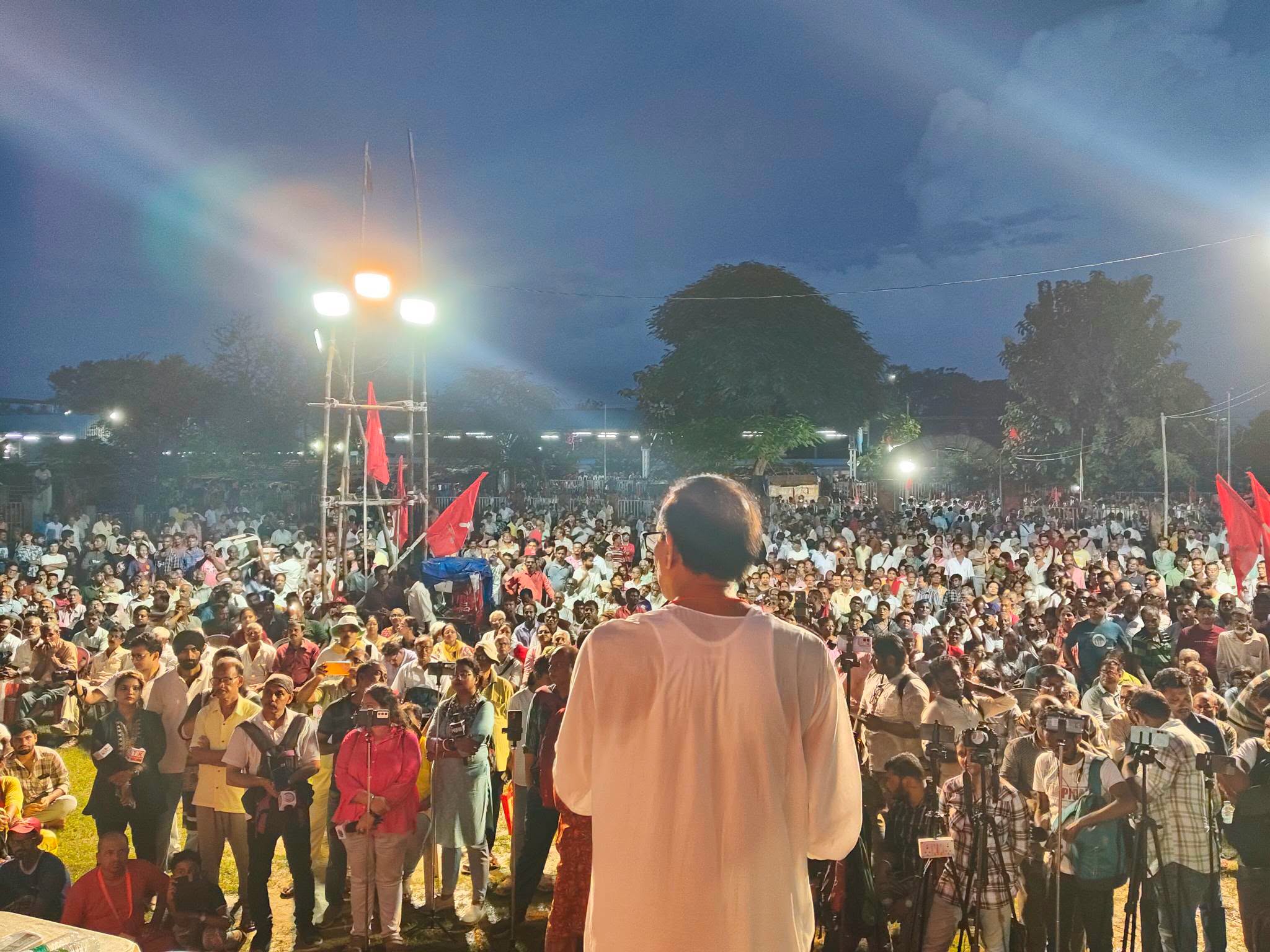
The extended meeting concluded on August 30, followed by a public rally at Rail Maidan beside Platform No. 4 of Kalyani railway station. The rally provided the organisational review with a broader public platform. Despite rain, thousands of people gathered, with supporters arriving from Palashi, Karimpur, Tehatta, Krishnaganj, Hanskhali, Ramghat, Santipur and Chakdaha, among other areas. Many travelled by train, bus and small vehicles, while others marched from Kalyani station to the meeting.
Speaking at the rally, Baby linked the organisational task before the party to the wider political struggle against the BJP. He said West Bengal had historically been an advanced base of the Left movement and that the revival of the Left in the state was necessary to counter “neo-fascism”. He called upon people to join the struggle under the red flag and said the future of Bengal lay in the path of the Left.
Salim said the party had entered a new phase in which the Left would directly confront the extreme Right. He argued that the principal test of opposition was not which party occupied opposition benches in the Assembly but which political force actually fought for the interests of poor and working people. He cited questions concerning schools, hospitals, employment, welfare payments and electoral rights as issues around which the Left would continue to organise.
CPI(M) Central Committee member Meenakshi Mukherjee also addressed the rally. She stressed the role of the Left in raising questions concerning jobs, education, healthcare and the rights of ordinary people. She called upon those who had supported the BJP in the hope of change to reconsider their position.
The public meeting was chaired by Nadia district secretary Meghlal Sheikh. Polit Bureau members Ramchandra Dom and Srideep Bhattacharya and other party leaders were present. IPTA artists performed mass songs.
The programme also reflected the organisational support generated around the meeting. Veteran trade union leader Motilal Chakraborty donated Rs 10,000 each to the CPI(M) party fund, Ganashakti fund, Jyoti Basu Centre for Social Studies and Research, PRC fund and Students Health Home, amounting to Rs 50,000. Ajit Kumar Ghosh donated Rs 25,000 to the party fund, while Shukla Bhattacharya donated Rs 5,000 to the Jyoti Basu Centre for Social Studies and Research.
THE PATH AHEAD
The extended meeting thus combined an assessment of the party’s organisational work with a review of the changing political situation in West Bengal and a call for stronger mass mobilisation. Nearly half the period since the 24th Party Congress has passed, Baby noted, making a review of the political, organisational and mass-movement situation necessary. The same process of review will be undertaken in Kerala at the CPI(M) state committee’s extended meeting from September 13 to 15.
For the West Bengal organisation, the immediate task identified through the two-day deliberations and the concluding public mobilisation is to translate the political assessment into stronger organisation and sustained struggles on issues affecting people’s lives, while rebuilding the Left’s position in the state.


