Pratik Mishra
THE continuing agitation of students and job aspirants in Jharkhand over irregularities in recruitment examinations conducted by the Jharkhand Public Service Commission (JPSC) and Jharkhand Staff Selection Commission (JSSC) reflects deep-seated anger among the youth. The CPI(M) Jharkhand State Committee has supported the genuine demands of the students and intervened in the movement while emphasising the need to preserve its democratic and independent character.
The agitation cannot be understood merely as a dispute over individual examinations. It is rooted in the wider crisis of unemployment, the shortage of quality permanent jobs and the weakening of public education. For a generation confronted with limited employment opportunities, government recruitment examinations have acquired enormous importance. The expansion of contractual and precarious employment, alongside the erosion of public education and the growth of private colleges and coaching centres, has placed enormous economic and social pressure on students and their families.
The increasing outsourcing of examination processes to private agencies has further compounded these problems. When thousands compete for a few hundred or even a few dozen posts after years of preparation and substantial expenditure, a paper leak, irregular evaluation, cancellation or manipulated result represents not merely an examination failure but the loss of years of effort and investment.
The Party has therefore supported the students' demands for transparent recruitment, accountability for irregularities and a fair opportunity for candidates. At the same time, the government must be held accountable for failures during its tenure and must take concrete steps to restore confidence in the recruitment process.
HISTORY OF FAILURES
The crisis, however, predates the present government. Successive governments have failed to establish a reliable recruitment system, with JPSC examinations repeatedly facing allegations of irregularities, revised results, disputes over evaluation and interview marks, answer-key errors and judicial intervention. The first and second JPSC examinations were transferred to the CBI following the Jharkhand High Court's intervention in 2012. The BJP-led government in Jharkhand also has a record of failure: during the five-year Raghubar Das government, not a single JPSC Civil Services examination was conducted.
This history does not absolve the present government. It must explain the irregularities that have occurred during its tenure, ensure accountability and undertake structural reforms. The government has taken some steps during the agitation, including discussions with student representatives, constitution of a committee, cancellation of certain examinations and announcements concerning recruitment reforms. However, these measures have not restored confidence, particularly on the questions of examination cancellations and an independent investigation.
The demand for a CBI investigation has consequently become an important issue. Given the loss of confidence in existing mechanisms, the demand for an independent investigation cannot simply be dismissed. At the same time, the experience of the CBI investigation into the earlier JPSC examinations demonstrates that merely transferring a case to the CBI does not guarantee timely justice. What is required is an investigation that is independent, transparent and time-bound, with responsibility fixed for those found guilty.
ROLE OF PARTY & MASS ORGANISATIONS
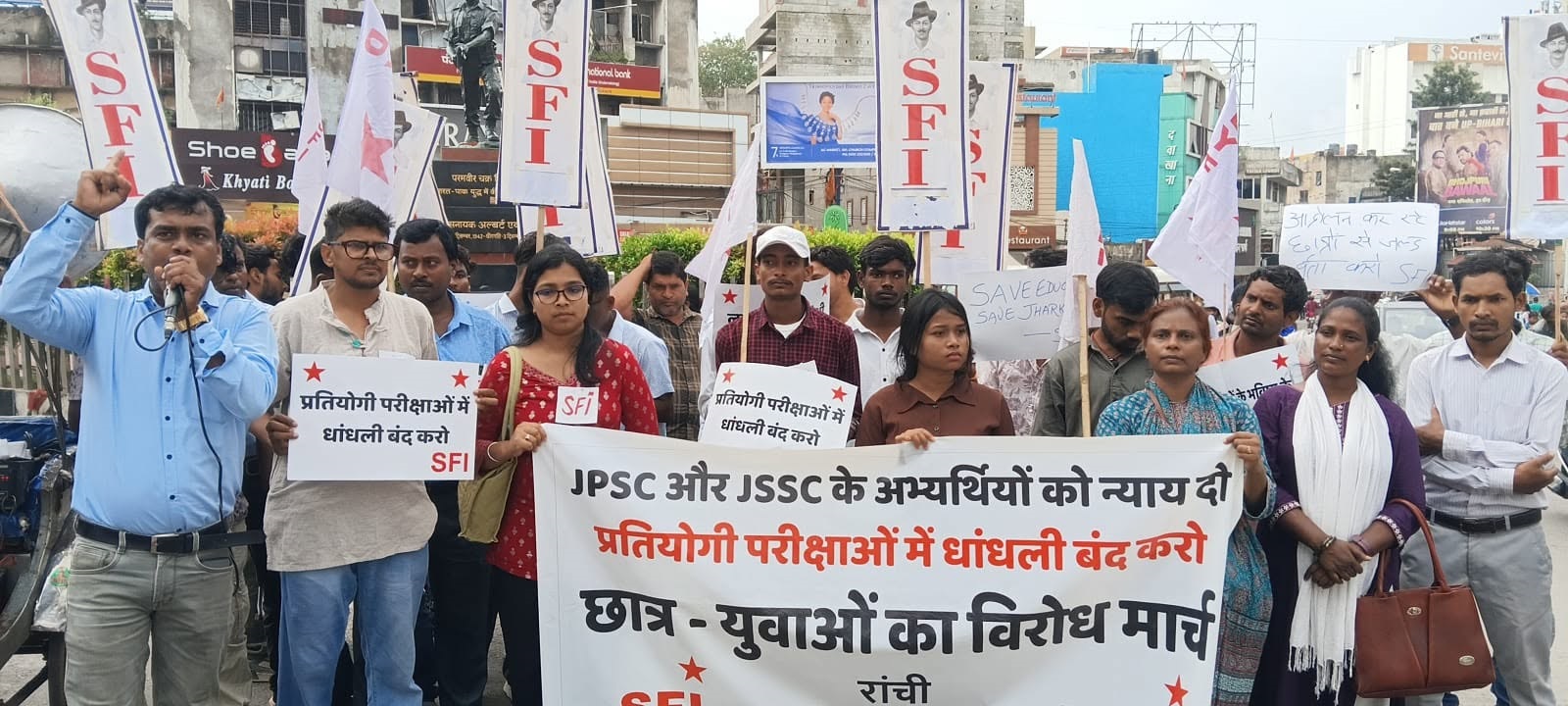
The Party has also taken concrete organisational initiatives in support of the students. SFI conducted an independent march jointly with DYFI, raising the issues of recruitment irregularities, employment and students' democratic rights. On August 7, SFI also participated in the joint Vidhan Sabha March organised with AISA and AISF.
The use of police force against protesting students on August 10 was wholly unacceptable. Students marching towards the Assembly faced water cannons, tear gas and lathi charge. The Party has opposed this repression and demanded that injured students receive proper treatment and that the circumstances leading to the police action be examined. The presence of disruptive elements brought in by the BJP cannot justify the use of force against the wider body of protesting students or undermine their genuine grievances.
BJP OPPORTUNISM
At the same time, the BJP-RSS intervention in the movement has to be politically understood. The anger of students over unemployment and recruitment irregularities is genuine and predates the present political mobilisation. Attempts to appropriate this anger for electoral purposes must therefore be resisted. The BJP's own record in Jharkhand and the continuing recruitment controversies in BJP-governed states make its attempt to present itself as the solution to the crisis particularly opportunistic.
The larger issues behind the agitation remain unemployment, inadequate recruitment and the commercialisation of education and examinations. Filling vacant government posts and creating quality permanent employment must be prioritised. Public schools, colleges and universities require greater investment, faculty and infrastructure rather than continued privatisation. Examination processes must be transparent, secure and publicly accountable, with clear responsibility for leaks, manipulation and negligence.
The Jharkhand student movement therefore represents a broader struggle for education, employment and a dignified future. The CPI(M) will continue to support the legitimate demands of the students, monitor the government's commitments, oppose repression and work through its student and youth organisations to strengthen democratic and independent mobilisation. The challenge is to turn the present anger into a sustained struggle for transparent recruitment, quality public education, secure employment and accountability.


