M A Baby
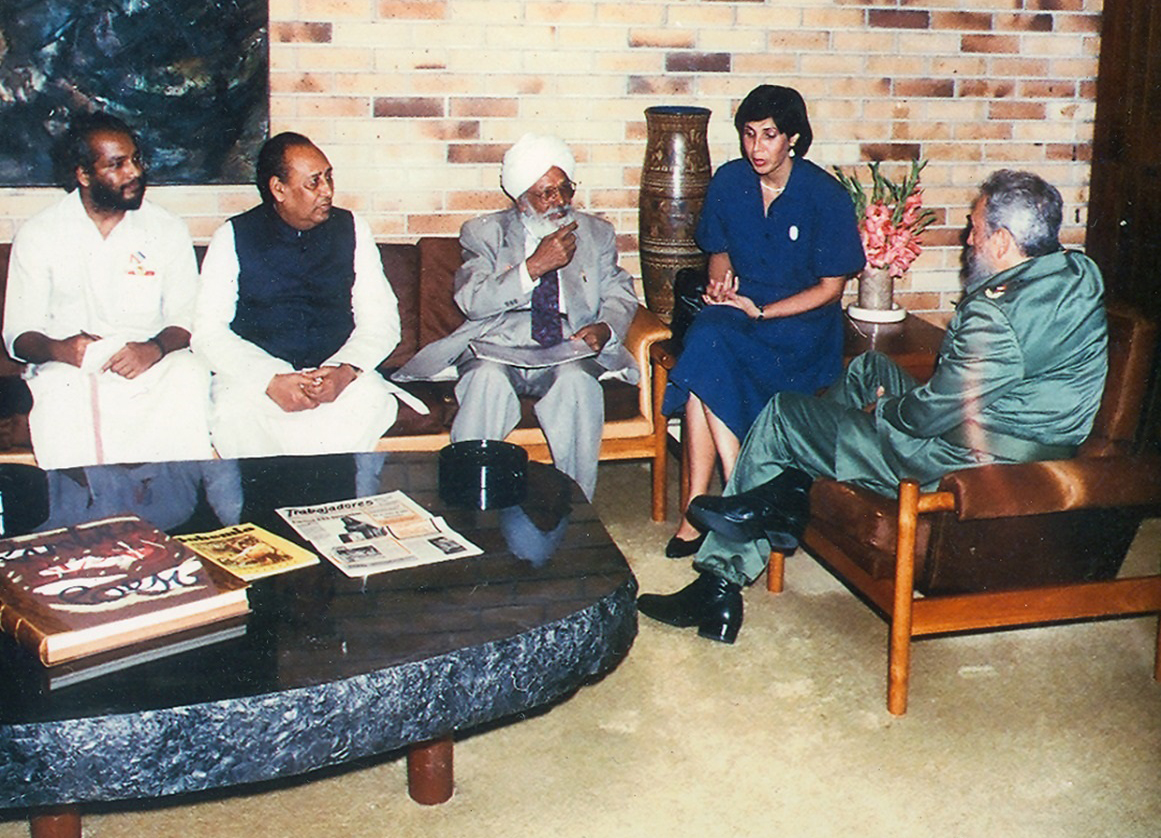
IT was in December 1992 that I had a direct interaction with Com. Fidel Castro. As part of the delegation led by Com. Harkishan Singh Surjeet, the then General Secretary of the CPI(M), I had travelled to Cuba to receive the Caribbean Princess, which had sailed from Haldia to Havana. The relief ship was carrying more than 10,000 tonnes of wheat raised by Indian farmers and workers, during Cuba’s severe economic ‘Special Period’, following the collapse of the Soviet Union.
During that trip, along with Com. Surjeet and Mr. K. N. Singh – a Rajya Sabha member from the Congress, with a communist past and an active participant of the Cuba Solidarity Movement in those days – I had the rare opportunity to spend close to three hours with Fidel, discussing issues from around the world. Incidentally, we had travelled to Cuba three weeks after the demolition of the Babri Masjid in Ayodhya, and naturally Fidel enquired about that too. He was curious to know the situation in India subsequent to the demolition. He expressed concern about the effect it would have on secularism in India and wondered about the tactics the right wing would use to grow amidst such a tense and charged atmosphere.
Despite living in a tiny island country that is almost 15,000 kilometers away from India, and which is only about 3.3 per cent the size of India, he was well informed of the developments here. Fidel was not keeping abreast with what was happening in India alone, he had a pulse on what was going on around the world. That is precisely why the world is missing him today. As we mark the centenary of Fidel Castro Ruz’s birth on August 13, 1926, in Birán, eastern Cuba, we are not merely remembering one of the greatest revolutionary leaders of all time. We are also measuring the void left by his departure, a void that is not abstract. It is political, and it is costing the lives and livelihoods of people around the world.
The Trump administration’s tariff wars, its gunboat diplomacy in the Caribbean, its threats of annexation against sovereign states, and its brazen collaboration in the genocide of the Palestinian people – these are not policy aberrations. They are the naked face of imperialist domination in its unipolar frenzy. The Global South today is crying out for a rallying voice, a leader capable of forging unity into a fighting force. The absence of a figure of Fidel’s stature is not a sentimental loss; it is a strategic deficit. That is why his life demands not remembrance, but study. Not nostalgia, but weaponisation.
FROM THE BALLOT TO MONCADA
As a student activist at Havana University, Fidel entered politics in the anti-colonial ferment of the late 1940s. His first instinct was electoral. He sought to enter the Cuban House of Representatives in 1952 as a candidate of the Orthodox Party. But on March 10, 1952, the US-backed butcher Fulgencio Batista suspended the constitution, cancelled the elections, and installed a dictatorship. Fidel first challenged the usurper in the courts. When the courts predictably capitulated, he drew the only conclusion a revolutionary can draw: that fascism in power does not yield to ballot papers, and that armed tyranny can be dismantled only by armed struggle.
On July 26, 1953, Fidel led 160 young rebels in simultaneous assaults on the Moncada barracks in Santiago de Cuba and Bayamo. The attack was militarily defeated. Batista’s thugs tortured and murdered dozens of captured revolutionaries. Yet from that defeat Fidel extracted a political victory that would reshape the world. He demonstrated that the Cuban people were not resigned to slavery, and that a new generation was willing to pay in blood for liberation.
THE JOSE MARTÍ CONNECTION
Put on trial in a farce of secret proceedings, Fidel – a trained lawyer – conducted his own defence. The world now knows that defence as Fidel’s ‘History Will Absolve Me’ speech. In it, he placed the intellectual authorship of the Cuban liberation project where it belonged; with José Martí, the apostle of Cuban independence, martyred in 1895, fighting Spanish colonialism. Martí was moral teacher, fearless combatant and a poet; for the Indian reader, he is the equivalent of Mahatma Gandhi, Bhagat Singh and Rabindranath Tagore fused into one national consciousness.
By declaring the young rebels of Moncada the ‘centenary generation’ of Martí, Fidel performed an act of political imagination that separated revolutionaries from mere insurrectionists. He grasped what many still fail to grasp; a revolution that disowns its past has no future. It will wither as an imported exotic. Fidel rooted Cuban socialism in Cuban soil, and in doing so made it indestructible. The Batista regime sentenced him to fifteen years imprisonment. But such was the popular fury across Cuba that the dictator was forced to release him under amnesty in less than two years. Batista thought he was freeing a prisoner. He was unleashing his own executioner.
BUILDING THE IMPOSSIBLE
Exiled, Fidel regrouped in Mexico. There he joined forces with a young Argentine doctor, Ernesto Che Guevara, forging one of the great revolutionary partnerships ever. In November 1956, eighty-two fighters sailed for Cuba in the yacht Granma. The landing was a disaster. Most were killed or captured. A ragged remnant reached the Sierra Maestra mountains. From that skeleton force, in barely twenty-five months, Fidel built a rebel army rooted in the peasantry, supported by urban workers and students, and capable of smashing a US-armed military machine. On January 1, 1959, Batista fled. The Cuban Revolution had triumphed.
Let us be clear about what this meant. The Cuban Revolution proved that socialism is not a geography-bound exception confined to the East. It proved that a socialist state can be built in the West, barely ninety miles from Florida, in the backyard of the most powerful imperialist power on earth and survive. Washington understood this threat to its ideological hegemony perfectly. That is why it launched the Bay of Pigs invasion in 1961, sponsored decades of terrorist aggression, and imposed an economic blockade that continues to this day. Cuba did not fail; it was punished for succeeding.
SOLIDARITY AS A WEAPON
Fidel never imagined the Cuban Revolution as Cuba’s private property. He turned it into a material base of support for liberation movements across Latin America and Africa. More than 300,000 Cuban volunteers fought in Angola. The 1988 victory at Cuito Cuanavale shattered the apartheid army, accelerated Namibian independence, and hastened the fall of the apartheid regime itself. Nelson Mandela travelled to Havana in 1991 to acknowledge this truth in person. Where US imperialism sent marines, Cuba sent doctors and teachers. Fidel provided decisive leadership to the Non-Aligned Movement, chairing it twice and hosting its 1979 Havana summit, insisting that non-alignment was not neutrality but alignment with the oppressed.
When the Soviet Union collapsed in 1991 and the ideologues of capital crowed about the ‘end of history’, Cuba lost 85 per cent of its trade overnight. The ‘Special Period’ was not an economic adjustment; it was an attempted strangulation. Fidel refused to surrender. He proved that socialism was never a Soviet franchise; it was, and remains, a choice made by a conscious people. It was during this crucible that I saw him in Havana – not bowed, not apologetic, but analysing, strategising, and drawing strength from international solidarity.
In those years, Fidel also expanded the very vocabulary of anti-imperialism. He named the debt trap, unequal exchange and neo-liberal plunder for what they were; new forms of imperialist exploitation. As early as the 1980s, he declared the foreign debt of the Third World unpayable and demanded that it not be paid. At the Rio Earth Summit in 1992, he warned – years before it became fashionable – that humanity itself was the biological species at risk of extinction through habitat destruction. He demanded reparations from former colonial powers for centuries of plunder, a demand that now echoes from the Caribbean to Africa to our own subcontinent.
A SYSTEM THAT COULD NOT BE KILLED
The CIA and its proxies attempted to assassinate Fidel more than 600 times, by Cuban security estimates. Every attempt failed. But those bullets were never meant for one man. They were aimed at the Cuban socialist system itself. Having survived them all, Fidel did what most leaders seldom do; he voluntarily stepped aside from 2006 onward, making way for younger comrades. His final decade was spent as a writer and counsellor of the Revolution until his death in November 2016.
The war against Cuba did not end with his passing. For over six decades, the United States has enforced an illegal blockade – condemned by the UN General Assembly in 2024 by 187 votes to 2 – that has cost the Cuban economy over $170 billion. The economic and infrastructural crisis gripping Cuba today is not a failure of socialism. It is the calculated cruelty of imperialism, tightened now under Trump. Let there be no confusion on this account.
A hundred years after his birth, Fidel, Che and the Cuban Revolution remain beacons for the Global South. In an era when imperialism has stripped off its mask and bares its fangs, his centenary is not a commemoration. It is a summons. The workers, peasants and youth of India and the world owe Comrade Fidel no greater tribute than this – to build the unity of the Global South, to resist every tariff, every invasion, every annexation, and to advance the struggle for socialism that was the meaning of his entire life. History has absolved him. Now we must vindicate him – on the streets, in the factories, in the fields, and in the battle of ideas. The absence is felt. But the duty is clear.


