Sudhanva Deshpande and Vijay Prashad
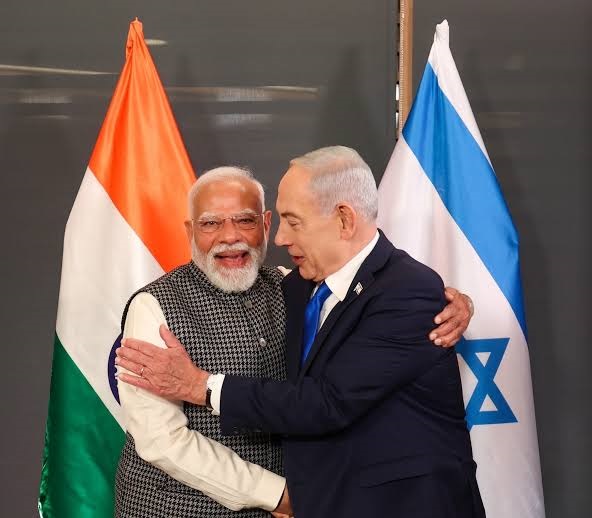
AMNESTY International’s new report, Made in India: The Supply of Weapons and Ammunition to Israel, tears away the diplomatic gauze with which the Narendra Modi government has covered its relationship with Israel. India continues to speak, now and then, of a two-state solution and humanitarian relief for Gaza. But beneath this thin vocabulary lies a dense traffic in gun parts, artillery shells, drone warheads, mortar launchers and components for armoured vehicles. The report shows that India is not merely standing beside Israel politically. It has become part of the supply chain that sustains Israel’s war machine.
Amnesty examined shipment-level trade data from October 7, 2023 to November 30, 2025. It identified 2,596 shipments of arms, ammunition, parts and military-vehicle components from India to Israel. Using an explicitly conservative method, Amnesty confirmed that Indian companies supplied at least 390,516 parts for military-grade small arms, 564,970 parts of explosive ordnance, and 298 components for military vehicles. Hundreds of ambiguous consignments were excluded, as were goods that might have been for civilian or purely defensive use. The actual scale of the trade is therefore likely to be considerably larger.
These are not abstractions hidden in customs classifications. PLR Systems, a joint venture between the Adani Group and Israel Weapon Industries, sent 10,571 feeding-tray parts for the Negev machine gun and 33,033 bolt carriers and related assemblies. Indo-MIM exported more than 59,637 automatic sears, the components that enable automatic fire. Kalyani Systems Strategic Limited sent 9,600 bodies for 155-mm artillery rounds to Israel Military Industries, now owned by Elbit Systems. Munitions India Limited, wholly owned by the Government of India, supplied 1,000 finished 155-mm high-explosive shells to Elbit. The list continues. Alpha Elsec, an Indo-Israeli joint venture, shipped 122 five-kilogram warheads to Elbit in December 2025. Amnesty connects this description to the SkyStriker loitering munition, fragments of which have been identified in Khan Younis. Advanced Weapons and Equipment India Limited, another state-owned company, exported 120 81-mm mortar launchers to Elbit in February 2024. India Optel Limited, also state-owned, sent sensors and interface boards to an Israeli company created by Elbit and Rafael. This is what ‘strategic partnership’ looks like when translated out of the bloodless language of joint statements.
THE ROAD TO WASHINGTON GOES THROUGH TEL AVIV
India recognised Israel in 1950 but did not establish full diplomatic relations until 1992. The familiar claim that this distance resulted from a supposed ‘Muslim lobby’ has always been a convenient communal explanation. It erases the secular and anti-colonial commitments that shaped Indian nationalism. India’s leaders understood that Zionism had produced an ethno-national state through the dispossession of the Palestinian people, and that Israel had attached itself first to British and French colonial power and then to United States imperial power.
Non-alignment was not simply a refusal to join one Cold War camp. It was a defence of anti-colonial sovereignty, the United Nations system and international law. Palestine condensed these commitments. India’s support for Palestinian self-determination was therefore not a favour bestowed upon Arab states, nor an electoral concession to Indian Muslims. It emerged from the same political horizon as solidarity with struggles in southern Africa and opposition to colonial domination.
That horizon began to fray with economic liberalisation and the Indian ruling class’s pursuit of a closer relationship with Washington. The road to Washington now ran through Tel Aviv. The Congress governments preferred a quiet alignment, especially through arms purchases and intelligence cooperation. The BJP turned this covert intimacy into an ideological embrace. Hindutva and Zionism share an affinity as projects of ethno-religious nationalism, and they share an anti-Muslim political grammar. Under Modi, the relationship no longer stops at India buying Israeli weapons. Israeli weapons are now partly made in India, while Indian firms feed Israel’s military-industrial complex.
Amnesty’s evidence therefore marks a new stage. India is no longer merely too cautious in its criticism of Israel, nor simply guilty of the immoral language of ‘both sides’ that equates an occupying power with an occupied people. Indian public and private industry is materially implicated in the apparatus of devastation.
THE GOVERNMENT CANNOT PLEAD IGNORANCE
After October 7, 2023, Israel inflicted an enormous assault on Gaza that destroyed homes, hospitals, schools, universities and systems of food and water. According to figures cited by Amnesty from the Palestinian Ministry of Health and the United Nations, by July 1, 2026 more than 73,000 Palestinians had been killed and over 173,500 injured, the vast majority civilians.
In January 2024, the International Court of Justice ordered binding provisional measures in South Africa v Israel, putting every government on notice of a serious risk of genocide. In July 2024, the Court found Israel’s continued occupation of the Palestinian territory unlawful. Amnesty, the United Nations Commission of Inquiry and a growing body of Palestinian, Israeli and international organisations have since concluded that Israel is committing genocide in Gaza. Whatever evasions were attempted in the first weeks of the assault are no longer available.
India is a party to the Genocide Convention and the Geneva Conventions. It has an obligation to employ all means reasonably available to prevent genocide and to ensure respect for international humanitarian law. A state must not transfer weapons where there is a clear risk that they will be used to commit or facilitate grave violations. Yet after the ICJ’s January 2024 order, the exports continued. In November 2025, India even signed a new memorandum with Israel on defence co-development and co-production. Nor can the government hide behind the fiction that these are autonomous commercial decisions. Munitions India, India Optel and Advanced Weapons and Equipment India are owned by the Union government; their leaders are appointed by the Cabinet and many of their employees remain government personnel. As Amnesty notes, entities of this character fall within the meaning of the ‘state’ under Article 12 of the Constitution. When they ship shells, sensors or launchers, the Indian state is not a distant regulator. It is a manufacturer and supplier.
Private firms do not escape responsibility. The government’s export-control system requires licences for munitions and other controlled goods, but the inter-ministerial process is opaque. It has produced no public evidence that India’s obligations under the Genocide Convention or the Geneva Conventions were seriously assessed. Corporations, meanwhile, have an independent duty to conduct heightened human-rights due diligence in a conflict zone. Compliance with an Indian licence cannot wash blood from a balance sheet.
In September 2024, the Supreme Court dismissed a petition seeking to halt arms exports to Israel. The Court pointed to foreign-policy questions, contractual liabilities and the executive’s statutory authority. The result, Amnesty observes, is that no effective judicial avenue has stopped the transfers. But executive discretion is not a legal vacuum. The government possesses the power to suspend licences; international law supplies the obligation. Its refusal to act is a political choice.
AN EMBARGO NOW
Amnesty calls on India to halt every transfer of arms, ammunition, parts, components, technology and military assistance to Israel; impose a comprehensive embargo; end business relationships with Elbit Systems, Rafael and Israel Aerospace Industries; investigate possible corporate complicity; reform the export-control regime; and join the Arms Trade Treaty. These are urgent minimum measures.
There is also a democratic task. Parliament must demand the publication of export licences, end-use assessments and the contracts of state-owned arms companies. Trade unions in the defence sector and at India’s ports can refuse to manufacture or move cargo destined for Israel’s military. Opposition parties, mass organisations and the Palestine solidarity movement must insist that no weapon made by Indian workers be used against the Palestinian people.
For decades, official India tried to preserve the appearance that friendship with Israel could coexist with support for Palestine. Amnesty’s report makes that posture untenable. The crates, manifests and corporate records tell a harder truth: the Modi government has carried India from political alignment with Israel towards possible complicity in its crimes. The answer cannot be another carefully balanced statement. It must be an immediate arms embargo, accountability for those who enabled these transfers, and the recovery of India’s anti-colonial commitment to a free Palestine.


