Manjeet Rathee
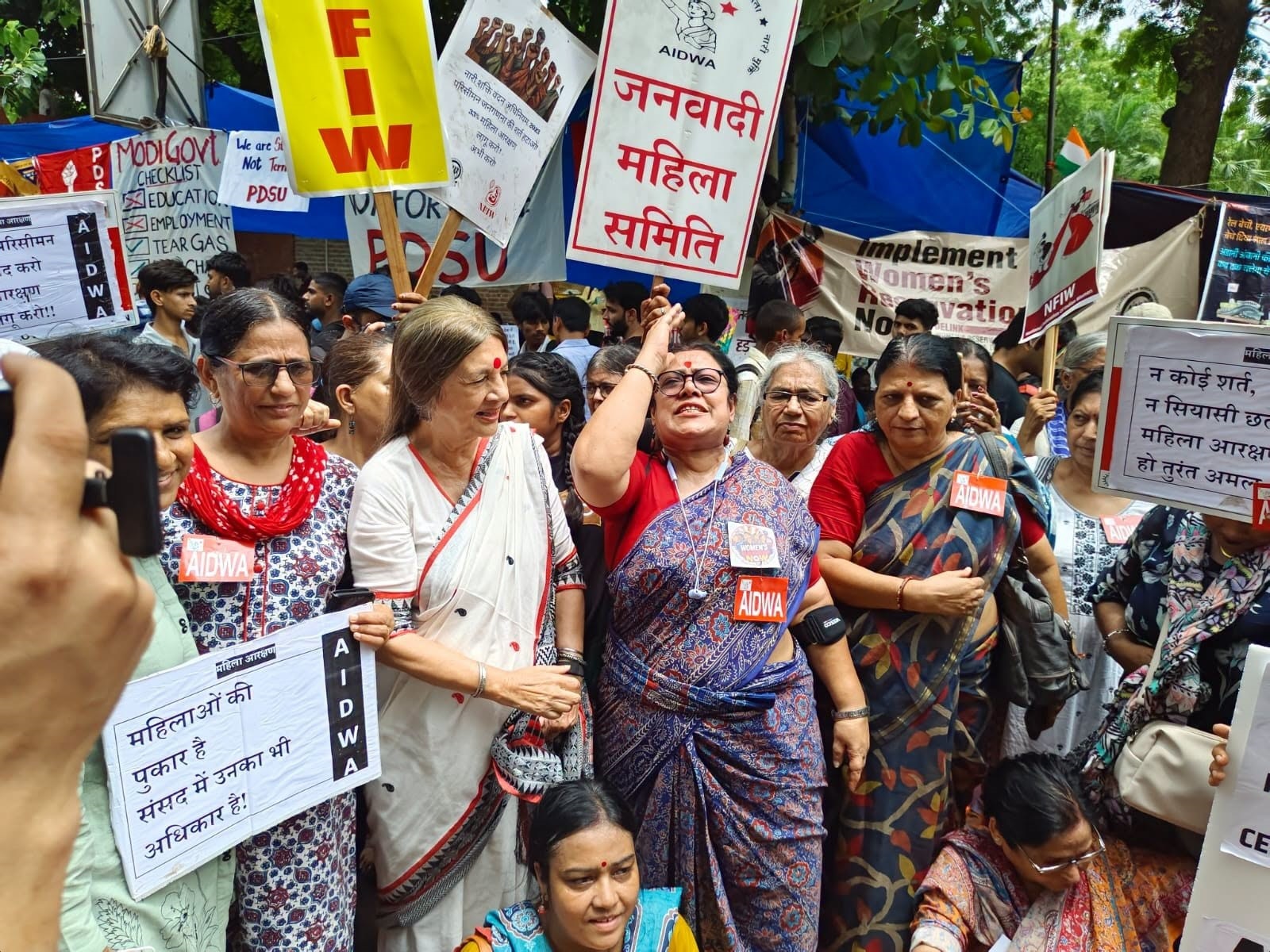
THE continuous dharna organised by the National Coalition for Women's Reservation (NCWR) at Jantar Mantar since the opening day of the Monsoon Session of Parliament on July 20 marks a significant moment in India's democratic and women's movements. Throughout the ten days of the ongoing dharna, the protesting women have stood firm, confronting all kinds of hurdles with remarkable determination that the promise of women's equal political representation cannot remain hostage to procedural delays, Manuvadi political maneuverings or shifting electoral priorities. The movement has transformed the demand for women's reservation from a periodic parliamentary debate into a sustained public campaign that refuses to let the issue disappear from the national agenda. The National Coalition of Women's Organisations, networks and civil society groups, have come together to demand the immediate implementation of the Women's Reservation Act by delinking it from any kind of conditionality. Apart from AIDWA, other women’s organisations that are part of the Coalition include NFIW, AIPWA, YWCA of India, ANHAD, Indian Christian Women’s Movement (ICWM), AIDMAM, Forum against Oppression of Women, Madhyam, One Billion Rising India, Vimochana, ATTWI, NCCI, UIC, Kuki-Zo-Forum, SNS, Unity in Compassion, and Together for Tranquility, along with some individuals like Leila Passah and Shabnam Hashmi.
AIDWA, which has been at the forefront of the countrywide campaigns for women's political rights since more than three decades, is playing a leading role in sustaining the dharna in the midst of all kinds of obstacles. Apart from carrying out a sustained campaign in their own States in favour of implementation of the Act, a large number of women from Delhi and neighbouring AIDWA State units such as Haryana have joined the protest each day braving scorching heat, torrential rains and all kinds of problems related to transport, police restrictions, heavy barricading and surveillance. Hundreds of women from Haryana and Delhi who have been part of the protest every single day, need to be applauded for their tireless efforts and exemplary mobilisation. Women from Madhya Pradesh joined the protest on July 24 to extend their solidarity and support. Women from far off States like Odisha, Maharashtra and Kerala also deserve appreciation for lending their strong voice to the protest. A sixteen-member delegation from Kerala was part of the protest ont July 30 and 31. The participation from these distant states has provided a strong impetus to the movement, apart from lending it a nation-wide character. Women from Rajasthan, Bihar, Himachal Pradesh, Uttarakhand, West Bengal, Panjab and Uttar Pradesh will also be joining the dharna in the coming days. AIDWA leaders who have constantly been part of the dharna include its President P K Sreemathi, General Secretary Kaninika Ghosh, Treasurer Taposhi Prahraj for a full week, Vice Presidents Mariam Dhawle, Punyavathi, Jagmati Sangwan, Secretaries Asha Sharma, Savita, Delhi Unit President Asha Yadav, Vice President Maimoona and Sehba Farooqi, Delhi Secretary Kavita Sharma, along with Manjeet Rathee and Sarbani Sarkar from the AIDWA Centre. AIDWA’s Vice President Sudha Sundarraman, Secretary C S Sujatha and Prachi Hatawlekar came all the way from Pondicherry, Kerala and Maharashtra respectively to extend their support and solidarity to the dharna.
The timing of the dharna is politically significant. By launching the protest on the very first day of the session and continuing it throughout, the whole Parliament session is accompanied by a reminder that millions of Indian women are still waiting for their constitutional promise to become a political reality. The protest on July 23 began with revolutionary tributes to Captain Lakshmi Sehgal, a renowned freedom fighter, Officer of the Indian National Army and one of the founding patrons of AIDWA, on her death anniversary. The visit to the dharna on this day by AIDWA’s senior leader and patron, Comrade Brinda Karat further energised the participants. While addressing the gathering, she expressed rage over the BJP’s government’s deliberate delay in the implementation of the Act owing to its patriarchal and conservative Manuvadi ideology that believes in confining women to their household chores and taking care of children. As a result, women of the country have been denied enhanced political participation in the 2024 Lok Sabha and ten subsequent state assembly elections, amounting to a grave injustice to their constitutional and democratic rights. She also asserted that the government's hypocrisy on the issue now stands completely exposed before the people of India. Another important contribution of the protest has been keeping pressure on various political parties. The representatives from NCWR have constantly been meeting the leaders, MPs and MLAs from different parties in various States as well as at the Centre, to garner maximum support for their demand. The MPs met by the delegation at the Centre include Abhay Kushwaha and Sudhakar Singh from RJD, Rajaram Singh and Sudama Prasad from CPIML (L), P. Sandosh Kumar and P P Suneer of CPI, and Dr Ravi Kumar from VCK (Viduthalai Chiruthaigal Katchi). The delegations at the state level have also met Tamilnadu’s current Chief Minister C. Joseph Vijay, Haryana ex-Chief Minister Bhupender Singh, Odisha’s ex-Chief Minister Naveen Patnaik, National President of Samajvadi Party Akhilesh Yadav, among others. All of them have assured the delegation of their support and solidarity.
Some of the current Left Members of Parliament have visited the protest site and expressed their solidarity with the ongoing dharna. Com Hannan Mollah, former eight-time Member of Parliament from West Bengal and Vice President of the All India Kisan Sabha, along with CPI(M) Members of Parliament Com V Sivadasan and Com John Brittas, visited the dharna on July 24, 29 and 31, respectively. Extending their unequivocal support to the movement and demanding the immediate implementation of the Women's Reservation Act, they assured the protesters that the issue would be forcefully raised during the current session of Parliament. They reiterated that the women of India have always won their rights through sustained struggles and would not allow the BJP government to evade its responsibility. The dharna also received solidarity from other democratic organisations. Com Shilpa, representing the Students' Federation of India (SFI), and Com Vikram Singh, National Joint Secretary of the All India Agricultural Workers Union (AIAWU), visited the protest site and extended support on behalf of their respective organisations.
The women's protest, which ran parallel to the students' and youth protest at Jantar Mantar from July 20 to 25, expressed complete solidarity with the young protesters demanding democratic rights, educational reforms, and accountability from the government in examination and recruitment processes. The women welcomed the successful culmination of the youth movement, which resulted in the resignation of Education Minister Dharmendra Pradhan. They hailed the courage and determination displayed by students and youth who fearlessly resisted the systematic degradation of the education system despite facing severe police repression and administrative intimidation. The young women who formed the backbone of the movement deserve special recognition for their extraordinary resilience and steadfastness in the face of repeated attempts to suppress their democratic voices. AIDWA strongly condemns the brutal police crackdown on the students and youth on July 20 and demands stringent action against all those responsible. The protest also unequivocally condemned the inflammatory and misogynistic remarks made by RSS leader T G Mohandas. His criminal call for violence against protesting students, coupled with his outrageous claim that secular women participating in the protests "enjoy" sexual assault and are themselves in favour of gang rape, amounts to an explicit incitement to violence. Such statements seek to legitimise sexual violence through vicious victim-blaming and reflect a deeply regressive, fascistic and Manuvadi mindset rooted in the ideology of the RSS.
One of the greatest strengths of the NCWR dharna has been its persistence and remarkable endurance. Women from different states have participated continuously despite extreme weather conditions, police intimidation and numerous logistical challenges. Equally significant has been the broad-based character of the movement, bringing together women, students, peasants and democratic organisations around the common demand for equal political representation. The dharna will continue until the last day of the current Parliament session. As part of its concluding phase, the National Coalition plans to organise a joint press conference on August 7, bringing together Members of Parliament, eminent personalities and representatives of democratic mass organisations. The ongoing protest is expected to culminate in a joint rally, reaffirming the movement's resolve to continue the struggle until the Women's Reservation Act is implemented without further delay.


